GHK-Cu (Copper Tripeptide-1): Gene Modulation and Extracellular-Matrix Research
Introduction
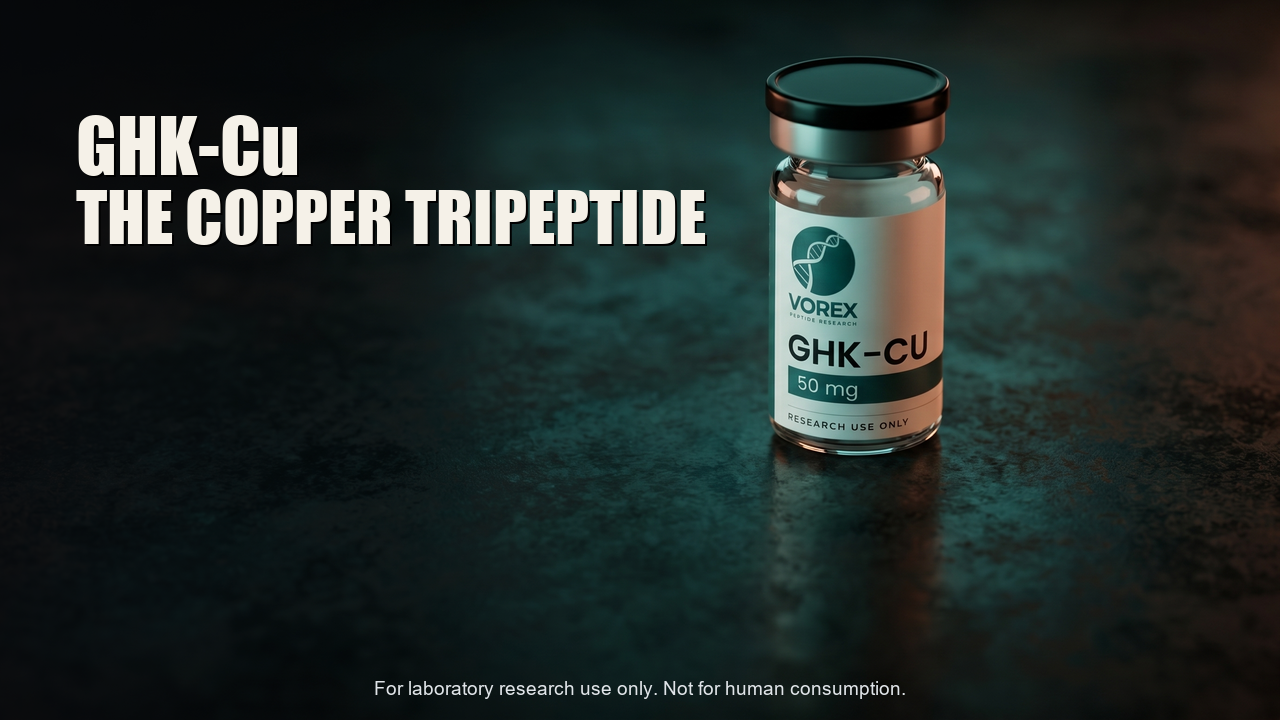
GHK-Cu is a small molecule with an outsized research footprint: a tripeptide, Glycyl-L-Histidyl-L-Lysine, that forms a high-affinity complex with copper(II) ions. Naturally occurring in human plasma, saliva, and urine, GHK was first noted for its activity in tissue-remodeling research and has since become a recurring tool in studies of extracellular-matrix (ECM) biology, gene expression, and antioxidant signaling. What makes it striking as a research subject is the breadth of its effects relative to its size — three amino acids and a copper ion associated, in microarray studies, with the modulation of thousands of genes. A further feature drives research interest: plasma GHK declines with age in human populations, from roughly 200 ng/mL around age 20 to approximately 80 ng/mL by age 60. This age-associated decline has motivated investigation of exogenous GHK-Cu in regenerative-biology models. This article surveys what the peer-reviewed literature describes about its mechanism, the gene-modulation findings that define it, how it is distinguished from related peptides, and how research-grade material is handled. Everything is framed strictly for laboratory research use only; the findings are model-system observations, not human outcomes, and nothing here describes or implies any human use.Mechanism of Action
GHK-Cu's biochemistry centers on copper coordination. The tripeptide binds copper(II) with high affinity, and the resulting complex is the biologically studied species — copper being essential to many enzymes involved in ECM synthesis and antioxidant defense. In research models, GHK-Cu is described as a copper-delivery and gene-modulating agent rather than a single-pathway signaling peptide (Pickart & Margolina, 2018). The hallmark of its mechanism is breadth. Microarray studies report that GHK-Cu modulates the expression of more than 4,000 human genes, shifting expression patterns associated with collagen and ECM-component synthesis, antioxidant-enzyme expression, and DNA-repair signaling. In dermal-fibroblast research, GHK-Cu exposure is associated with upregulated synthesis of collagen, elastin, and proteoglycans — the structural molecules of the extracellular matrix (Pickart et al., 2015).Mechanism of Action — Deep Dive
Copper as the active partner. GHK alone and GHK-Cu are not interchangeable in research terms; the copper complex is the species associated with most of the characterized activity. Copper is a cofactor for enzymes such as lysyl oxidase (involved in collagen and elastin cross-linking) and superoxide dismutase (antioxidant defense), which helps explain why a copper-binding tripeptide would influence ECM and redox pathways (Pickart & Margolina, 2018). Gene modulation rather than single signaling. The defining research observation is the scale of GHK-Cu's transcriptional effects. Rather than activating one receptor or pathway, microarray data describe it resetting expression across thousands of genes toward patterns associated with repair and remodeling. This positions GHK-Cu as a tool for studying coordinated gene-expression programs, not a narrow agonist (Pickart & Margolina, 2018). The age-decline rationale. The documented decline of plasma GHK with age (≈200 ng/mL at 20 to ≈80 ng/mL at 60) is the mechanistic motivation for studying exogenous GHK-Cu in regenerative models — a decline-and-restoration framing analogous to other age-associated molecules, and always presented as a model-system rationale rather than a human claim.Key Research Findings
The findings below are model-system observations from the peer-reviewed literature — not human outcomes and not human-use guidance.Finding 1 — Broad gene-expression modulation
Type of evidence: microarray and gene-data review (Pickart & Margolina, 2018). Finding: GHK-Cu modulates expression of more than 4,000 human genes, with coordinated effects on ECM, antioxidant, and DNA-repair pathways. Why it matters: it establishes GHK-Cu as a broad transcriptional modulator and the conceptual basis for its ECM research (Pickart & Margolina, 2018).Finding 2 — Upregulation of ECM components in fibroblasts
Type of evidence: in vitro dermal-fibroblast research (Pickart et al., 2015). Finding: GHK-Cu exposure is associated with upregulated synthesis of collagen, elastin, and proteoglycans. Why it matters: it links the transcriptional effects to measurable changes in ECM-component production (Pickart et al., 2015).Finding 3 — Tissue-remodeling kinetics in repair models
Type of evidence: preclinical wound-healing research summarized in the reviews. Finding: GHK-Cu is associated with acceleration of tissue-remodeling markers in repair models. Why it matters: it gives GHK-Cu a functional readout in defined repair platforms (Pickart & Margolina, 2018).Related Compounds Comparison Table
| Molecule | Identity | Relationship to GHK-Cu | Research framing |
|---|---|---|---|
| GHK-Cu | Gly-His-Lys + copper(II) | The reference complex | Copper-delivery, gene-modulating ECM agent |
| GHK (apo) | The tripeptide without copper | The metal-free form | Less active than the copper complex in research |
| BPC-157 | 15 aa peptide | Combined in GLOW/KLOW blends | Angiogenesis; cytoprotection |
| TB-500 | 43 aa peptide | Combined in GLOW/KLOW blends | Actin sequestration; migration |
Research Applications
Within laboratory settings, research-grade GHK-Cu is studied in ECM-biology assays, fibroblast gene-expression studies (including microarray and qPCR readouts), antioxidant-pathway investigation, and wound-healing/dermal-repair research. It functions as a defined reference input for probing coordinated gene-expression programs and copper-dependent ECM pathways. Researchers commonly pair GHK-Cu studies with collagen/elastin assays and transcriptional profiling to connect copper coordination to functional ECM outcomes. Across all designs, GHK-Cu serves as a tool for interrogating ECM and gene-expression biology, never as a product for application outside the laboratory.Storage & Handling Protocols for Research Use
Research-grade GHK-Cu is typically supplied as a lyophilized powder, chosen because dry material is far more stable than material in solution. The considerations below are general laboratory-storage practice, not instructions for any human use. Dry powder is commonly stored at −20 °C or colder (often −80 °C for archival material), protected from moisture by desiccant and shielded from light; the copper complex also warrants protection from prolonged light exposure. Because the powder is hygroscopic, laboratories equilibrate a sealed vial to room temperature before opening. Material in solution is less stable, with stability sensitive to pH (which affects copper coordination), temperature, and freeze–thaw cycling, so many groups prepare small single-use aliquots. Because no generic shelf life can be assumed, research groups validate stability empirically. VOREX does not provide reconstitution recipes, concentrations, or use protocols; those decisions sit with the qualified researcher.Laboratory Handling & Best Practices
Record the vial's lot number against every experiment, with working aliquots inheriting it.Use clean glassware and PPE, document storage history and freeze–thaw count, and weigh small quantities on a calibrated analytical balance, accounting for the hygroscopic tendency of lyophilized powders. None of these practices involves dosing, route of administration, or human-use preparation; they exist to protect data integrity and reproducibility.What the Research Doesn't Tell Us
The literature is candid about its limits. The breadth of GHK-Cu's gene-modulation makes attribution difficult — when a single agent shifts thousands of genes, isolating which changes drive a given readout requires careful controls. Much of the data is in vitro or from animal models framed as model-system observations, and the age-decline-and-restoration narrative is a research rationale, not a human claim. Results in one cell type or model may not generalize, and the dependence of activity on copper coordination means handling and pH conditions can materially affect outcomes. For the researcher, GHK-Cu is best approached as a broad, actively studied modulator where controls and careful handling matter.Conclusion
GHK-Cu research describes a copper-binding tripeptide whose defining feature is the breadth of its gene-modulating activity — thousands of genes shifted toward ECM-remodeling and repair-associated patterns. Anchored by the documented age-related decline of plasma GHK, it is a mechanism worth measuring rather than a claim worth selling, and for laboratories working on ECM and gene-expression biology it remains a foundational reference material. View research data · Request COA · Explore mechanism studiesReferences
- Pickart, L., & Margolina, A. (2018). Regenerative and Protective Actions of the GHK-Cu Peptide in the Light of the New Gene Data. International Journal of Molecular Sciences, 19(7), 1987. https://pubmed.ncbi.nlm.nih.gov/29986520/
- Pickart, L., Vasquez-Soltero, J.M., & Margolina, A. (2015). GHK Peptide as a Natural Modulator of Multiple Cellular Pathways in Skin Regeneration. BioMed Research International, 2015, 648108. https://pubmed.ncbi.nlm.nih.gov/26236730/
For laboratory and research use only (RUO). Not for human consumption, diagnostic, or therapeutic use. VOREX products are intended exclusively for in vitro research conducted by qualified professionals. Statements have not been evaluated by the FDA. These products are not intended to diagnose, treat, cure, or prevent any disease.