The 2X Blend (CJC-1295 + Ipamorelin): A GH-Axis Research Combination
Introduction
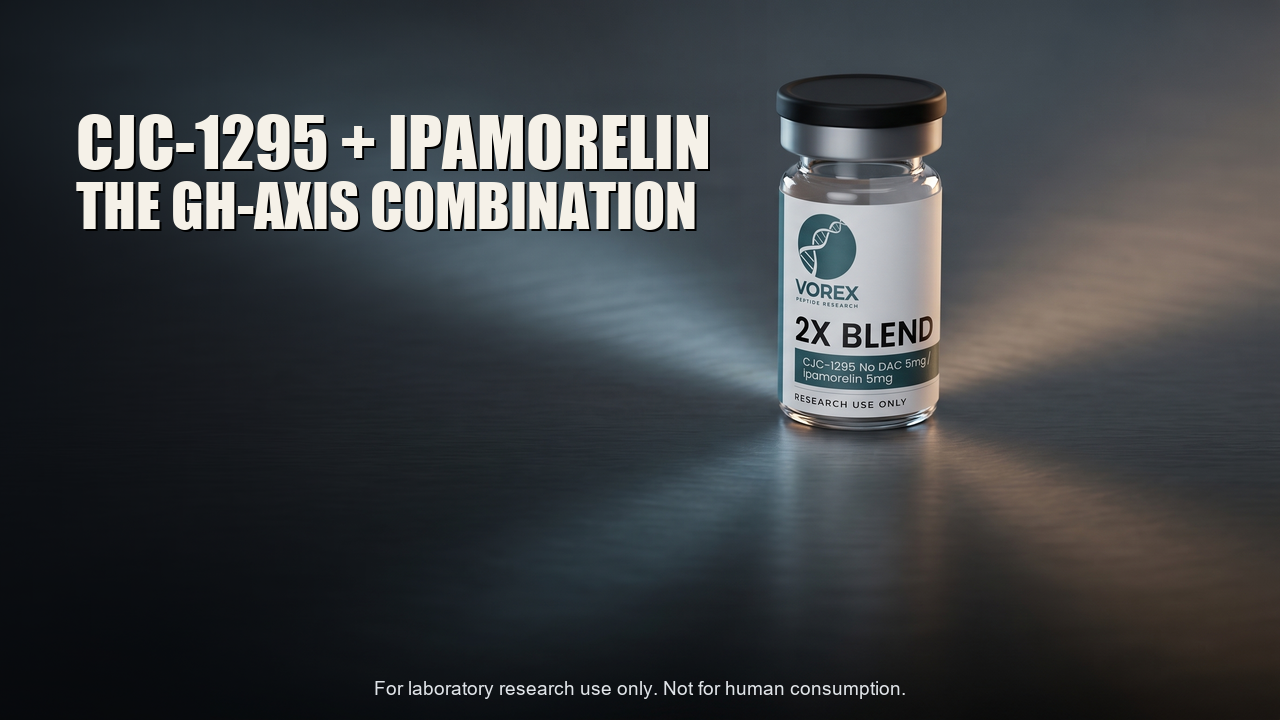
The 2X blend pairs two peptides that act on the growth-hormone (GH) axis through different receptors: CJC-1295, a long-acting analog of growth-hormone-releasing hormone (GHRH), and ipamorelin, a selective agonist of the growth hormone secretagogue receptor (GHS-R1a). It is one of the most classic combinations in GH-axis research, studied because the two molecules provide complementary, mechanistically distinct inputs to the same population of pituitary cells. Rather than a single molecule, the 2X blend is studied by reference to the established research base of its two components and the rationale for combining a GHRH-receptor input with a GHS-R1a input. This article surveys what the peer-reviewed literature describes about each component, why they are combined, the principal findings, and how research-grade material is handled. Everything is framed strictly for laboratory research use only; the findings are model-system observations, not human outcomes, and nothing here describes or implies any human use.Mechanism of Action
GH secretion from the anterior pituitary is governed by two stimulatory systems and one inhibitory system. GHRH, acting on its own receptor, stimulates GH synthesis and release; the ghrelin/GHS-R1a system provides a second stimulatory input; and somatostatin inhibits. The 2X blend engages both stimulatory arms simultaneously. CJC-1295 — the GHRH-receptor input. CJC-1295 is a synthetic GHRH (1-29) analog with four amino-acid substitutions (D-Ala, Gln, Ala, Leu) that confer resistance to enzymatic degradation. The "DAC" (Drug Affinity Complex) version adds a maleimidopropionic-acid linker that covalently binds circulating albumin, extending plasma half-life from minutes to approximately 8 days. In research models it acts as a long-acting GHRH-receptor agonist at pituitary somatotrophs (Teichman et al., 2006). Ipamorelin — the GHS-R1a input. Ipamorelin is a selective GHS-R1a agonist pentapeptide characterized as the first GH secretagogue with minimal effect on cortisol, prolactin, or ACTH (Raun et al., 1998). Because the two act through different receptors, the combination is studied on the premise that the two stimulatory inputs are complementary.Mechanism of Action — Deep Dive
Two receptors, one cell. The mechanistic interest in the 2X blend is that GHRH-receptor and GHS-R1a signaling converge on the same somatotrophs through partly distinct intracellular pathways. Studying them together lets researchers examine how two stimulatory inputs interact at the level of GH release — a question that neither component alone can address. Pharmacokinetic complementarity. The DAC form of CJC-1295 provides sustained GHRH-receptor stimulation (an ~8-day half-life), while ipamorelin acts on a shorter timescale through GHS-R1a. Notably, research on continuous GHRH-analog stimulation reported that pulsatile GH secretion persists even under sustained stimulation, an important consideration for interpreting combined-input experiments (Ionescu & Frohman, 2006). Why combine rather than fuse. As with other two-peptide blends, the 2X combination achieves multi-input coverage by co-administration rather than within a single molecule. This separability is a research advantage: each component can be studied independently and together, allowing the GHRH and GHS-R1a contributions to be attributed directly.Key Research Findings
The findings below are model-system observations from the peer-reviewed literature — not human outcomes and not human-use guidance.Finding 1 — Extended pharmacokinetics of CJC-1295 (DAC)
Type of evidence: clinical pharmacology study (Teichman et al., 2006). Finding: CJC-1295 with DAC produced sustained increases in GH and IGF-1 with an extended half-life of approximately 8 days in research subjects. Why it matters: it defines the long-acting GHRH-receptor input that anchors the combination (Teichman et al., 2006).Finding 2 — Persistence of pulsatile GH secretion
Type of evidence: clinical pharmacology study (Ionescu & Frohman, 2006). Finding: pulsatile GH secretion persisted during continuous stimulation by the long-acting GHRH analog. Why it matters: it informs how sustained GHRH-receptor stimulation is interpreted in combination research (Ionescu & Frohman, 2006).Finding 3 — Selectivity of the GHS-R1a component
Type of evidence: comparative pharmacology study (Raun et al., 1998). Finding: ipamorelin provides a selective GHS-R1a input with minimal off-target pituitary effects. Why it matters: it ensures the GHS-R1a arm of the combination is a clean input (Raun et al., 1998).Related Compounds Comparison Table
| Component | Class | Target receptor | Half-life note |
|---|---|---|---|
| CJC-1295 (DAC) | GHRH analog | GHRH receptor | ~8 days (albumin-bound) |
| CJC-1295 (no DAC) | Mod GRF (1-29) | GHRH receptor | ~30 minutes (pulsatile protocols) |
| Ipamorelin | Pentapeptide | GHS-R1a | Short-acting, selective |
Research Applications
Within laboratory settings, the 2X components are studied in GHRH-receptor and GHS-R1a pharmacology, growth-hormone-pulsatility research, and albumin-binding drug-delivery research (for the DAC linker). The blend's value for comparative work is that its components can be studied individually and together, allowing each input's contribution to GH release to be examined. Researchers commonly pair these studies with GH and IGF-1 measurements to characterize the combined input. Across all designs, the materials serve as tools for interrogating GH-axis pharmacology, never as products for application outside the laboratory.Storage & Handling Protocols for Research Use
Research-grade CJC-1295 and ipamorelin are typically supplied as lyophilized peptide powders, chosen because dry material is far more stable than material in solution. The considerations below are general laboratory-storage practice, not instructions for any human use. Dry powder is commonly stored at −20 °C or colder (often −80 °C for archival material), protected from moisture by desiccant and shielded from light. Because the powders are hygroscopic, laboratories equilibrate a sealed vial to room temperature before opening. Material in solution is prone to degradation, with stability sensitive to pH, temperature, and freeze–thaw cycling, so many groups prepare small single-use aliquots. Because no generic shelf life can be assumed, research groups validate stability empirically. VOREX does not provide reconstitution recipes, concentrations, or use protocols; those decisions sit with the qualified researcher.Laboratory Handling & Best Practices
Record each component's lot number against every experiment, with working aliquots inheriting it.For a two-component blend, traceability of each component is essential. Use clean glassware and PPE, document storage history and freeze–thaw count, and weigh small quantities on a calibrated analytical balance. None of these practices involves dosing, route of administration, or human-use preparation.What the Research Doesn't Tell Us
The literature is candid about its limits. Because the 2X blend is a combination, attributing a given effect to the GHRH arm, the GHS-R1a arm, or their interaction requires careful factorial design. Much of the pharmacokinetic data comes from defined study contexts, and results under one regimen may not generalize. The interaction between sustained GHRH-receptor stimulation and pulsatile GHS-R1a input is itself an active research question. For the researcher, the 2X blend is best approached as a combination whose component contributions and interaction are the central question.Conclusion
The 2X blend research describes a combination of two GH-axis inputs — the long-acting GHRH analog CJC-1295 and the selective GHS-R1a agonist ipamorelin — studied for how complementary stimulatory signals converge on pituitary GH release. Anchored by each component's peer-reviewed base, it is a combination worth investigating rather than a claim worth selling, and for laboratories working on the GH axis its components remain valuable reference materials. View research data · Request COA · Explore mechanism studiesReferences
- Teichman, S.L., Neale, A., Lawrence, B., Gagnon, C., Castaigne, J.P., & Frohman, L.A. (2006). Prolonged stimulation of growth hormone and IGF-I secretion by CJC-1295, a long-acting analog of GH-releasing hormone, in healthy adults. Journal of Clinical Endocrinology and Metabolism, 91(3), 799–805. https://pubmed.ncbi.nlm.nih.gov/16352683/
- Ionescu, M., & Frohman, L.A. (2006). Pulsatile secretion of growth hormone persists during continuous stimulation by CJC-1295, a long-acting GHRH analog. Journal of Clinical Endocrinology and Metabolism, 91(12), 4792–4797. https://pubmed.ncbi.nlm.nih.gov/16985012/
- Raun, K., Hansen, B.S., Johansen, N.L., Thøgersen, H., Madsen, K., Ankersen, M., & Andersen, P.H. (1998). Ipamorelin, the first selective growth hormone secretagogue. European Journal of Endocrinology, 139(5), 552–561. https://pubmed.ncbi.nlm.nih.gov/9849822/
For laboratory and research use only (RUO). Not for human consumption, diagnostic, or therapeutic use. VOREX products are intended exclusively for in vitro research conducted by qualified professionals. Statements have not been evaluated by the FDA. These products are not intended to diagnose, treat, cure, or prevent any disease.