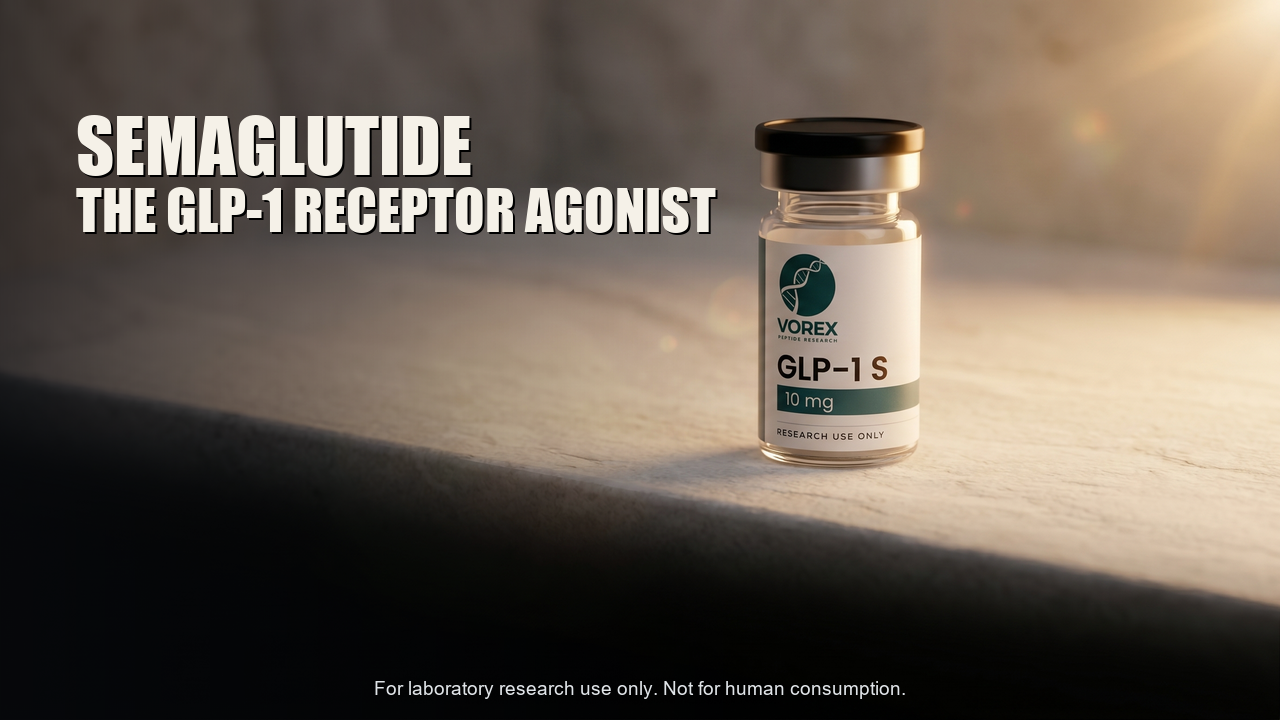
Semaglutide: The Reference GLP-1 Receptor Agonist in Metabolic Research
Introduction
Semaglutide is a synthetic, long-acting analog of glucagon-like peptide-1 (GLP-1) and, in research terms, the reference compound against which newer incretin molecules are measured. Where dual and triple agonists engage two or three receptors, semaglutide acts on a single target — the GLP-1 receptor — and does so with a degree of characterization that few peptides match. For a researcher studying incretin biology, it is the baseline: the molecule whose well-mapped pharmacology defines what "GLP-1-receptor agonism" means before any additional receptor arm is layered on. Structurally, semaglutide is an acylated peptide with high sequence homology (approximately 94%) to native human GLP-1, modified with amino-acid substitutions that resist enzymatic degradation and a fatty-diacid chain that promotes albumin binding. Together these confer a protracted half-life consistent with once-weekly administration in the published protocols. This article surveys what the peer-reviewed literature describes about its mechanism, the discovery rationale behind its design, the principal findings from the published phase 3 program, how it is distinguished from multi-receptor agonists, and how research-grade material is characterized and handled. Everything is framed strictly for laboratory research use only; clinical findings are reported as observations from the published literature, not as claims about VOREX material and not as any form of human-use guidance.Mechanism of Action
Semaglutide is a selective agonist of the GLP-1 receptor, a class-B G-protein-coupled receptor. In the broader incretin literature, GLP-1-receptor activation potentiates glucose-dependent insulin secretion from pancreatic beta cells — meaning insulin release is amplified in proportion to glucose availability rather than driven unconditionally — and is associated, in model systems, with suppression of glucagon secretion, slowed gastric emptying, and central effects on appetite-regulating circuits in the hypothalamus and hindbrain. The molecular design that makes semaglutide useful as a research tool is its stability and exposure profile. Native GLP-1 is degraded within minutes by the enzyme dipeptidyl peptidase-4 (DPP-4); semaglutide's substitutions blunt that degradation, and its albumin-binding acyl chain extends circulation time dramatically (Knudsen & Lau, 2019). The result is a single chemical entity that produces sustained GLP-1-receptor engagement, making it a clean instrument for studying the consequences of prolonged single-receptor agonism.Mechanism of Action — Deep Dive
The DPP-4 problem and its solution. The central engineering challenge for any GLP-1-based molecule is degradation. Knudsen and Lau describe how semaglutide's structural modifications — including substitution at the DPP-4 cleavage site and a C18 fatty-diacid linker — convert a peptide with a minutes-long half-life into one suitable for weekly dosing (Knudsen & Lau, 2019). For researchers, this means semaglutide can be used to interrogate steady-state GLP-1-receptor signaling rather than the transient pulses that native GLP-1 produces. Central versus peripheral signaling. A recurring theme in the GLP-1 literature is the distinction between peripheral effects (insulin secretion, glucagon suppression, gastric emptying) and central effects (appetite regulation through receptor-expressing neurons). Semaglutide is studied as a tool for probing this central–peripheral balance, because its sustained exposure engages both compartments. Disentangling which contributions drive a given readout is an active research question, and the molecule's well-defined pharmacology makes it the preferred reagent for such work. Why it is the reference. Because semaglutide acts on only the GLP-1 receptor, it provides the cleanest available baseline for comparative pharmacology. When a dual agonist such as tirzepatide or a triple agonist such as retatrutide is studied, semaglutide is the natural comparator that isolates what the additional receptor arms contribute.Key Research Findings
The findings below are drawn from the peer-reviewed discovery and clinical literature, presented as observations reported in those studies — not as outcomes attributable to VOREX material and not as human-use guidance.Finding 1 — Engineered GLP-1-receptor agonist with extended exposure
Type of evidence: mechanistic and pharmacology review (Knudsen & Lau, 2019). Method context: receptor-binding and signaling characterization combined with pharmacokinetic analysis of the acylated design. Finding: semaglutide was characterized as a selective GLP-1-receptor agonist whose modifications confer resistance to DPP-4 and a half-life supporting once-weekly administration. Why it matters: it defines the reference pharmacology for the entire incretin-agonist field (Knudsen & Lau, 2019).Finding 2 — Dose-titrated body-weight change (STEP-1)
Type of evidence: randomized, double-blind, placebo-controlled phase 3 trial (Wilding et al., 2021). Method context: 1,961 adults with overweight or obesity without diabetes, randomized to semaglutide 2.4 mg or placebo over 68 weeks. Finding: mean body-weight change at 68 weeks was −14.9% with semaglutide versus −2.4% with placebo. Why it matters: it provides the quantitative single-receptor benchmark against which multi-receptor agonists are compared (Wilding et al., 2021).Finding 3 — Glycemic effects in type 2 diabetes (STEP-2)
Type of evidence: randomized, double-blind, placebo-controlled phase 3 trial (Davies et al., 2021). Method context: adults with type 2 diabetes randomized across semaglutide doses and placebo. Finding: semaglutide produced reductions in body weight and glycemic markers relative to placebo in the studied population. Why it matters: it extends the reference dataset into a glycemic-control context (Davies et al., 2021).Related Compounds Comparison Table
This comparison is descriptive biochemistry intended to orient research design; none of these molecules is presented for any human use.| Molecule | Receptor profile | Relationship to semaglutide | Primary research framing |
|---|---|---|---|
| Semaglutide | GLP-1 (single) | The reference molecule | Selective GLP-1 receptor agonist |
| Tirzepatide | GIP + GLP-1 (dual) | Adds a GIP arm | Dual "twincretin" agonist |
| Retatrutide | GIP + GLP-1 + glucagon (triple) | Adds GIP and glucagon arms | Triple agonist |
| Cagrilintide | Amylin-receptor agonist | Different family; combined with semaglutide as CagriSema | Amylin analog studied alongside GLP-1 agonism |
Research Applications
Within laboratory settings, research-grade semaglutide is studied as a reference material in GLP-1-receptor pharmacology assays, in comparative work that isolates the GLP-1 contribution within multi-receptor agonists, and in models of glucose handling and energy balance. Its value lies precisely in being a single-receptor standard: a defined input whose effects can be subtracted from those of broader agonists to attribute specific outcomes to specific receptors. Receptor-selective antagonists are frequently paired with semaglutide to confirm that an observed effect is GLP-1-receptor-mediated, and exposure-response interpretation accounts for the engineered pharmacokinetics. Across all designs, semaglutide functions as a tool for interrogating incretin signaling, never as a product for application outside the laboratory.Storage & Handling Protocols for Research Use
Research-grade semaglutide is typically supplied as a lyophilized peptide powder, chosen because dry material is far more stable than material in solution. The considerations below are general laboratory-storage practice, not instructions for any human use. Dry powder is commonly stored at −20 °C or colder (often −80 °C for archival material), protected from moisture by desiccant and shielded from light. Because the powder is hygroscopic, laboratories typically equilibrate a sealed vial to room temperature before opening. Material in solution is prone to aggregation, surface adsorption, and hydrolysis, with stability sensitive to pH, temperature, and freeze–thaw cycling, so many groups prepare small single-use aliquots. Because no generic shelf life can be assumed, research groups validate stability empirically. VOREX does not provide reconstitution recipes, concentrations, or use protocols; those decisions sit with the qualified researcher.Laboratory Handling & Best Practices
Good handling centers on traceability. Record the vial's lot number against every experiment, and have working aliquots inherit it.Use clean glassware and appropriate PPE, document storage history and freeze–thaw count, and weigh small quantities on a calibrated analytical balance, accounting for the hygroscopic tendency of lyophilized powders. None of these practices involves dosing, route of administration, or human-use preparation; they exist to protect data integrity and reproducibility.What the Research Doesn't Tell Us
Even for a molecule this well-characterized, the literature acknowledges open questions. The human efficacy data come from trials designed to characterize defined endpoints over defined windows, not to resolve every mechanistic detail of central-versus-peripheral signaling. Effects observed under one exposure regimen may not generalize to another, and results in one study population cannot be assumed to hold in another. The relative contributions of appetite regulation, gastric emptying, and insulin secretion to any composite readout remain an active area of study. For the researcher, semaglutide is best treated as a well-mapped but still-evolving reference point rather than a closed book.Conclusion
Semaglutide research describes a selective, long-acting GLP-1-receptor agonist whose stable single-receptor pharmacology has made it the reference standard for the incretin field. The published phase 3 program supplies a quantitative single-receptor benchmark, and its fixed profile makes it the natural comparator for every dual- and triple-receptor agonist that followed. It is a mechanism worth measuring, and for laboratories working on incretin biology it remains a foundational reference material. View research data · Request COA · Explore mechanism studiesReferences
- Knudsen, L.B., & Lau, J. (2019). The Discovery and Development of Liraglutide and Semaglutide. Frontiers in Endocrinology, 10, 155. https://pubmed.ncbi.nlm.nih.gov/31031702/
- Wilding, J.P.H., Batterham, R.L., Calanna, S., Davies, M., Van Gaal, L.F., Lingvay, I., et al. (2021). Once-Weekly Semaglutide in Adults with Overweight or Obesity. New England Journal of Medicine, 384(11), 989–1002. https://pubmed.ncbi.nlm.nih.gov/33567185/
- Davies, M., Færch, L., Jeppesen, O.K., Pakseresht, A., Pedersen, S.D., Perreault, L., et al. (2021). Semaglutide 2·4 mg once a week in adults with overweight or obesity, and type 2 diabetes (STEP 2). The Lancet, 397(10278), 971–984. https://pubmed.ncbi.nlm.nih.gov/33667417/
For laboratory and research use only (RUO). Not for human consumption, diagnostic, or therapeutic use. VOREX products are intended exclusively for in vitro research conducted by qualified professionals. Statements have not been evaluated by the FDA. These products are not intended to diagnose, treat, cure, or prevent any disease. Clinical findings described above are reported from the published peer-reviewed literature and are not claims regarding VOREX research material.