CJC-1295 With DAC: The Long-Acting GHRH Analog and Its Albumin-Binding Drug Affinity Complex in Research
Introduction
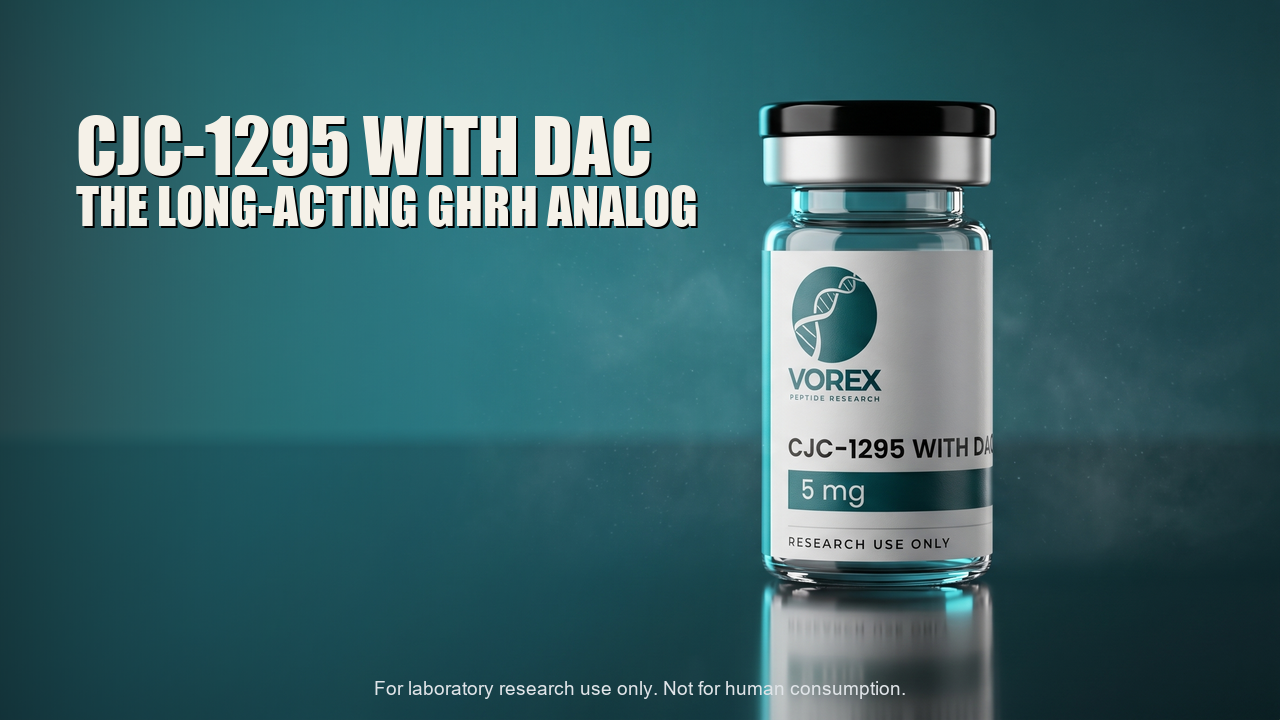
Among the synthetic analogs of growth-hormone-releasing hormone (GHRH), CJC-1295 With DAC is defined first and foremost by one property: it is long-acting. Where the unmodified GHRH 1-29 fragment survives in circulation for only minutes, CJC-1295 With DAC is characterized in the clinical literature by a circulating half-life extended toward approximately eight days. That single design achievement — turning a minutes-long peptide into a days-long one — is what makes the molecule a distinctive reference tool for laboratories studying the growth-hormone axis. This article focuses on the molecular architecture that produces that long-acting behavior: the GHRH 1-29 backbone, the four amino-acid substitutions that resist enzymatic degradation, and the maleimidopropionic-acid Drug Affinity Complex (DAC) that covalently tethers the peptide to circulating albumin. Everything here is framed strictly for laboratory research use only. The observations are drawn from research models and the published clinical literature; they are not human outcomes attributable to VOREX material, and nothing here describes, recommends, or implies any human use, anti-aging application, growth-hormone therapy, or therapeutic effect of any kind.Mechanism of Action
CJC-1295 is a synthetic analog of GHRH 1-29 — the N-terminal 29-amino-acid fragment that the peptide literature identifies as the minimal active region of native growth-hormone-releasing hormone. In research models, this fragment binds the GHRH receptor, a class-B G-protein-coupled receptor expressed on the somatotroph cells of the anterior pituitary. Receptor engagement is the upstream event in the growth-hormone axis: the signal that, in the literature, is associated with stimulation of endogenous growth-hormone synthesis and release. What distinguishes CJC-1295 from the unmodified fragment is engineering for persistence. The molecule carries four amino-acid substitutions (D-Ala, Gln, Ala, Leu) that confer resistance to the enzymatic degradation — particularly dipeptidyl peptidase-4 cleavage at the N-terminus — that rapidly clears the native sequence. Layered on top of that is the DAC: a maleimidopropionic-acid linker that covalently binds circulating albumin, converting a transiently present peptide into one that remains associated with the body's most abundant plasma protein for days (Teichman et al., 2006). The result is a long-acting GHRH-receptor agonist whose activity in research models still depends on intact downstream pituitary machinery.Mechanism of Action — Deep Dive
The GHRH 1-29 core. Peptide hormones frequently concentrate their receptor-activating information in a defined sub-region, and GHRH is a textbook case: the N-terminal 1-29 segment retains full growth-hormone-releasing activity. CJC-1295 inherits this active core, so at the level of receptor binding it behaves as a functional GHRH analog. The engineering is therefore additive — it preserves the receptor-engaging chemistry while solving the durability problem that limits the parent fragment. Four substitutions for enzymatic resistance. The unmodified GHRH 1-29 sequence is intrinsically fragile, cleared on a timescale of minutes largely through proteolysis. CJC-1295's four substitutions (D-Ala, Gln, Ala, Leu) are positioned to blunt that degradation, producing the "Mod GRF 1-29" backbone whose stability is already improved over the native fragment before any albumin chemistry is applied. In research terms, these substitutions are the first layer of half-life extension. The Drug Affinity Complex. The defining feature of the DAC variant is the maleimidopropionic-acid linker. A maleimide group reacts selectively and covalently with a reactive cysteine thiol — and circulating albumin presents such a thiol. The peptide therefore conjugates in situ to albumin, the most abundant plasma protein, and rides the slow clearance kinetics of that carrier. This is what extends the circulating half-life of the unmodified fragment from minutes toward approximately eight days in research subjects (Teichman et al., 2006). The albumin tether does not change the receptor the peptide engages; it changes how long the peptide remains available to engage it.Key Research Findings
The findings below are model-system and published-clinical-literature observations — not human outcomes attributable to VOREX material and not human-use guidance.Finding 1 — A long-acting GHRH analog with an ~8-day half-life
Type of evidence: clinical-literature pharmacokinetic characterization (Teichman et al., 2006). Method context: pharmacokinetic profiling of CJC-1295 With DAC in research subjects. Finding: the maleimidopropionic-acid DAC covalently binds circulating albumin, extending the circulating half-life of the GHRH fragment from minutes toward approximately eight days. Why it matters: it establishes CJC-1295 With DAC as the long-acting member of the GHRH-analog family and a defined reference point for half-life-extension chemistry (Teichman et al., 2006).Finding 2 — Substitution-plus-DAC architecture
Type of evidence: structure-activity description in the GHRH-analog literature (Teichman et al., 2006). Method context: characterization of the modified GHRH 1-29 backbone and its albumin-binding linker. Finding: four amino-acid substitutions resist enzymatic degradation while the DAC linker adds covalent albumin binding, two complementary layers of half-life extension built onto the active 1-29 core. Why it matters: it clarifies that the long-acting profile arises from defined molecular features rather than from any change in the receptor target (Teichman et al., 2006).Finding 3 — Receptor target preserved despite continuous presence
Type of evidence: GHRH-axis pharmacodynamic literature (Ionescu & Frohman, 2006). Method context: examination of GHRH-receptor stimulation under sustained exposure to a long-acting analog. Finding: even with a circulating analog present for days, the molecule continues to act at the anterior-pituitary GHRH receptor, the same upstream target engaged by the native fragment. Why it matters: it localizes CJC-1295's activity to a specific, well-characterized receptor system, distinguishing it from exogenous growth hormone, which bypasses the pituitary entirely (Ionescu & Frohman, 2006).Related Compounds Comparison Table
This comparison is descriptive biochemistry intended to orient research design; none of these molecules is presented for any human use.| Molecule | Class | GHRH-axis research arm | Relationship to CJC-1295 With DAC |
|---|---|---|---|
| CJC-1295 With DAC | Modified GHRH 1-29 analog + DAC | Long-acting GHRH-receptor stimulation (~8-day half-life) | The reference molecule (this article) |
| Sermorelin (GHRH 1-29) | GHRH 1-29 fragment (29 aa) | Minimal active GHRH-receptor agonist, short-acting | Unmodified short-acting parent fragment |
| Mod GRF 1-29 (CJC without DAC) | Modified GHRH 1-29 analog | GHRH stimulation, ~30-min half-life | Same backbone, no albumin linker |
| Ipamorelin | GHS-R1a pentapeptide | Selective ghrelin-receptor agonism | Complementary, distinct receptor (GH axis) |
Research Applications
Within laboratory settings, research-grade CJC-1295 With DAC is studied as a defined long-acting GHRH-receptor reference agonist. Typical research contexts include GHRH-receptor binding and signaling assays, albumin-binding drug-delivery investigations in which the DAC strategy serves as a model for half-life extension, and comparative pharmacology in which a days-long analog is evaluated against short-acting GHRH fragments. Because the molecular architecture is fully defined, the peptide also functions as an analytical reference standard for identity and purity work in GHRH-analog studies. Across all of these designs, CJC-1295 With DAC serves as a tool for interrogating GHRH-receptor pharmacology and albumin-binding chemistry in vitro and in research models, never as a product intended for application outside the laboratory.Storage & Handling Protocols for Research Use
Research-grade CJC-1295 With DAC is typically supplied as a lyophilized peptide powder, a format chosen because dry material is markedly more stable than material in solution. The considerations below are general laboratory-storage practice and are not instructions for any human use. Dry powder is commonly stored at −20 °C or colder, with many laboratories using −80 °C for archival material, the vial protected from moisture by desiccant and shielded from light. Because the powder is hygroscopic, laboratories typically allow a sealed vial to equilibrate to room temperature before opening. Material brought into solution is far less stable than the dry form — prone to aggregation, surface adsorption, and hydrolysis, with stability sensitive to pH, temperature, and freeze–thaw cycling — so many groups prepare small single-use aliquots rather than repeatedly thawing one tube. Because the maleimide chemistry of the DAC is reactive, laboratories also note that reconstituted material may interact with thiol-bearing components, another reason empirical stability validation is preferred over assumed shelf life. VOREX does not provide reconstitution recipes, concentrations, or use protocols; those decisions sit with the qualified researcher.Laboratory Handling & Best Practices
Sound handling of a research reference peptide is largely about traceability and documentation. Record the vial's lot number against every experiment, and have any working aliquot inherit the parent lot identifier.Use clean glassware and appropriate personal protective equipment, document storage history and freeze–thaw count, and weigh small quantities on a calibrated analytical balance, accounting for the hygroscopic tendency of lyophilized powders. None of these practices involves dosing, route of administration, or human-use preparation; they exist to protect data integrity and reproducibility.What the Research Doesn't Tell Us
The literature is candid about the limits of this work. Characterizing the albumin-binding DAC and the ~8-day half-life describes the pharmacokinetics of the molecule, but circulating persistence in a research subject does not establish whole-organism outcomes, and it says nothing about human application. The four substitutions and the maleimide linker are well defined chemically, yet the practical behavior of the conjugate depends on the experimental system, the albumin source, and assay conditions. Much of the foundational pharmacokinetic characterization rests on a small number of studies, so some mechanistic detail is inferred from the broader GHRH-analog literature rather than from CJC-1295-specific work. And the translational distance between a defined half-life measurement and any real-world application is rarely small. For the researcher, CJC-1295 With DAC is best treated as a well-characterized but deliberately bounded long-acting GHRH-receptor reference tool.Conclusion
CJC-1295 With DAC is the long-acting member of the GHRH-analog family: a GHRH 1-29 active core, four substitutions for enzymatic resistance, and a maleimidopropionic-acid Drug Affinity Complex that covalently binds circulating albumin to extend half-life from minutes toward approximately eight days. Its value as a research material lies precisely in that engineered persistence — it is a defined system for studying GHRH-receptor pharmacology and albumin-binding half-life extension, not a claim worth selling. For laboratories working on the growth-hormone axis and peptide drug-delivery chemistry, CJC-1295 With DAC remains a focused and informative reference material. View research data · Request COA · Explore mechanism studiesReferences
- Teichman, S.L., Neale, A., Lawrence, B., Gagnon, C., Castaigne, J.P., & Frohman, L.A. (2006). Prolonged stimulation of growth hormone (GH) and insulin-like growth factor I secretion by CJC-1295, a long-acting analog of GH-releasing hormone, in healthy adults. Journal of Clinical Endocrinology and Metabolism, 91(3), 799–805. https://pubmed.ncbi.nlm.nih.gov/16352683/
- Ionescu, M., & Frohman, L.A. (2006). Pulsatile secretion of growth hormone (GH) persists during continuous stimulation by CJC-1295, a long-acting GHRH analog. Journal of Clinical Endocrinology and Metabolism, 91(12), 4792–4797. https://pubmed.ncbi.nlm.nih.gov/16985012/
For laboratory and research use only (RUO). Not for human consumption, diagnostic, or therapeutic use. VOREX products are intended exclusively for in vitro research conducted by qualified professionals. Statements have not been evaluated by the FDA. These products are not intended to diagnose, treat, cure, or prevent any disease.