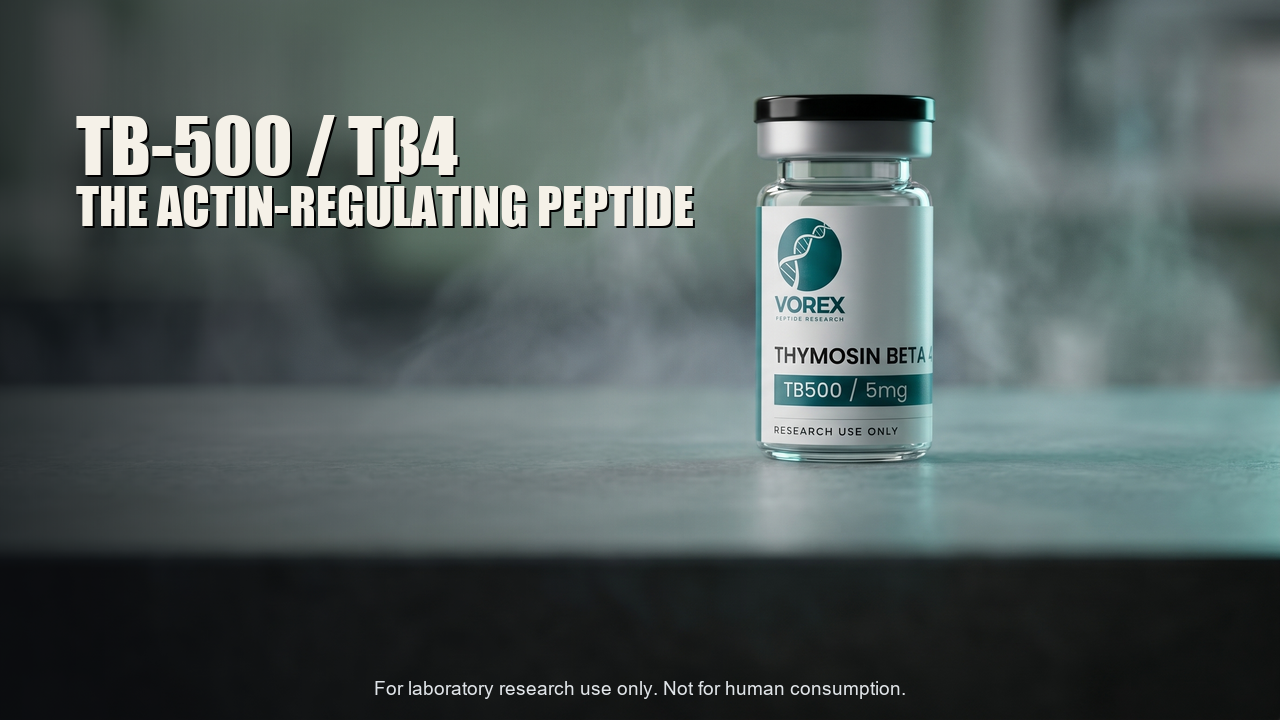
TB-500 (Thymosin Beta-4): The Actin-Sequestering Peptide in Tissue-Repair Research
Introduction
TB-500 is the research designation commonly used for Thymosin Beta-4 (Tβ4), a 43-amino-acid peptide that is among the most abundant intracellular proteins in mammalian cells. Originally isolated from thymus tissue, Tβ4 is now studied less as an immune factor and more as a master regulator of the actin cytoskeleton — the protein scaffold that governs cell shape, migration, and structural remodeling. Its primary biochemical activity is the sequestration of G-actin, the monomeric form of actin, which positions it at the center of cell-migration and tissue-repair research.
TB-500 is frequently studied alongside BPC-157 in the "Wolverine" research blend, pairing two of the most extensively investigated tissue-repair peptides. This article surveys what the peer-reviewed literature describes about its mechanism, the research behind its actin-regulating and angiogenic activity, the principal preclinical findings, how it compares to related repair peptides, and how research-grade material is handled. Everything is framed strictly for laboratory research use only; the findings are model-system observations, not human outcomes, and nothing here describes or implies any human use.
Mechanism of Action
Tβ4's defining biochemical role is the sequestration of G-actin. Actin exists in two states — globular monomers (G-actin) and filamentous polymers (F-actin) — and the dynamic balance between them drives the cytoskeletal rearrangements underlying cell migration, division, and structural change. By binding G-actin monomers, Tβ4 maintains a regulated pool of unpolymerized actin, modulating how readily cells can build and remodel their cytoskeleton (Goldstein et al., 2005).
Beyond this core activity, the research literature describes additional effects: promotion of VEGF-mediated angiogenesis, anti-inflammatory signaling associated with inhibition of the NF-κB pathway, and the release of the tetrapeptide acetyl-SDKP (acSDKP), which has its own characterized roles in angiogenesis and tissue remodeling. Together these position Tβ4 as a multifunctional regulator in wound-healing and repair models.
Mechanism of Action — Deep Dive
The actin-sequestration mechanism. Cell migration — central to wound healing — requires continuous assembly and disassembly of the actin cytoskeleton at the leading and trailing edges of a moving cell. Tβ4's regulated buffering of the G-actin pool is the mechanistic basis for its association with enhanced cell motility in research models. This makes it a tool for studying the cytoskeletal dynamics of migration rather than a simple "growth" factor (Goldstein et al., 2005).
Angiogenesis and acSDKP. A recurring theme is Tβ4's connection to new blood-vessel formation. The literature describes both direct effects on endothelial cells and indirect effects via acSDKP, a cleavage-derived tetrapeptide with characterized pro-angiogenic activity. In tissue-repair models, angiogenesis is a prerequisite for sustained remodeling, which is why this arm of Tβ4 biology recurs in the research.
The Wolverine-blend rationale. In the Wolverine research blend, Tβ4 is combined with BPC-157, a peptide studied for angiogenesis (via the VEGFR2 pathway) and cytoprotection. The rationale described for such combinations is that the two peptides engage partly distinct repair-relevant pathways — cytoskeletal regulation and angiogenic/cytoprotective signaling — making the combination a subject of interest in tissue-repair research. As with all blends, the components are characterized individually rather than as a unified product.
Key Research Findings
The findings below are drawn from the peer-reviewed literature, presented as model-system observations — not human outcomes and not human-use guidance.
Finding 1 — Actin sequestration as the core activity
Type of evidence: integrative review of Tβ4 biology (Goldstein et al., 2005). Method context: biochemical characterization combined with cell- and animal-model studies across multiple tissues. Finding: Tβ4 functions as the principal G-actin-sequestering peptide, regulating cytoskeletal dynamics central to cell migration and tissue remodeling. Why it matters: it establishes the mechanistic basis for nearly all downstream repair-model work (Goldstein et al., 2005).
Finding 2 — Accelerated reepithelialization in wound models
Type of evidence: controlled animal wound-healing study (Malinda et al., 1999). Method context: Tβ4 administration in full-thickness wound models with quantification of reepithelialization over time. Finding: reepithelialization was increased by 42% at 4 days and 61% at 7 days relative to controls. Why it matters: it provides a concrete, quantified functional signal that anchors the wound-healing research (Malinda et al., 1999).
Finding 3 — Multi-tissue repair and progenitor biology
Type of evidence: body of research summarized across reviews. Finding: Tβ4 activity has been described in dermal repair, corneal healing, hair-follicle research, and cardiac models, including reactivation of dormant epicardial progenitor cells in cardiac-infarction models. Why it matters: it explains why Tβ4 recurs across diverse tissue-repair research platforms (Goldstein et al., 2005).
Related Compounds Comparison Table
This comparison is descriptive biochemistry; none of these molecules is presented for any human use.
| Molecule | Length / class | Primary research activity | Relationship to TB-500 |
|---|---|---|---|
| TB-500 / Tβ4 | 43 aa peptide | G-actin sequestration; angiogenesis | The reference molecule |
| BPC-157 | 15 aa peptide | Angiogenesis (VEGFR2); cytoprotection | Paired with TB-500 in the Wolverine blend |
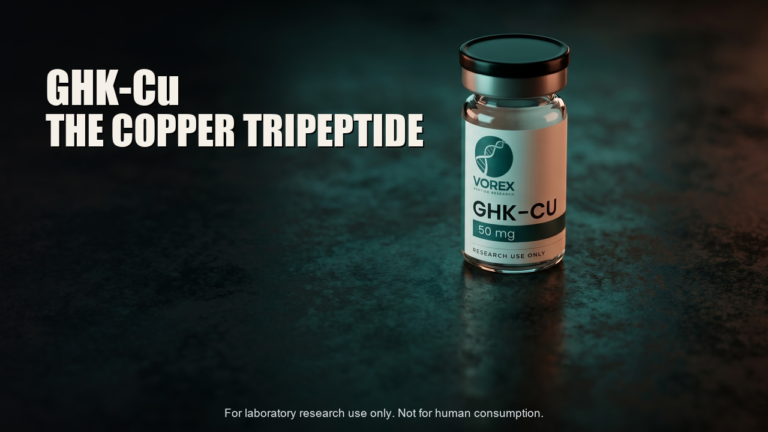
| GHK-Cu | Tripeptide–copper complex | ECM remodeling; gene modulation | Combined with both in the GLOW blend |
| acSDKP | Tetrapeptide | Pro-angiogenic; anti-fibrotic | A Tβ4-derived cleavage fragment |
Research Applications
Within laboratory settings, research-grade TB-500 is studied in actin-cytoskeleton assays, cell-migration and wound-healing-kinetics research, angiogenesis assays, and cardiac progenitor-cell biology. It functions as a defined reference input for probing cytoskeletal and repair-related pathways. Researchers commonly pair Tβ4 studies with actin-polymerization assays, migration assays (such as scratch or transwell models), and angiogenesis readouts to connect its biochemistry to functional outcomes. Across all designs, TB-500 serves as a tool for interrogating tissue-repair biology, never as a product for application outside the laboratory.
Storage & Handling Protocols for Research Use
Research-grade TB-500 is typically supplied as a lyophilized peptide powder, chosen because dry material is far more stable than material in solution. The considerations below are general laboratory-storage practice, not instructions for any human use. Dry powder is commonly stored at −20 °C or colder (often −80 °C for archival material), protected from moisture by desiccant and shielded from light. Because the powder is hygroscopic, laboratories equilibrate a sealed vial to room temperature before opening. Material in solution is prone to aggregation, adsorption, and hydrolysis, with stability sensitive to pH, temperature, and freeze–thaw cycling, so many groups prepare small single-use aliquots. Because no generic shelf life can be assumed, research groups validate stability empirically. VOREX does not provide reconstitution recipes, concentrations, or use protocols; those decisions sit with the qualified researcher.
Laboratory Handling & Best Practices
Record each vial's lot number against every experiment, with working aliquots inheriting it.Use clean glassware and PPE, document storage history and freeze–thaw count, and weigh small quantities on a calibrated analytical balance, accounting for the hygroscopic tendency of lyophilized powders. None of these practices involves dosing, route of administration, or human-use preparation; they exist to protect data integrity and reproducibility.
What the Research Doesn't Tell Us
The literature is candid about its limits. Much of the strongest data comes from animal wound and cardiac models, which the reviews frame as model-system observations rather than human outcomes. The relative contributions of actin sequestration, direct angiogenic effects, and acSDKP-mediated signaling to any composite repair readout are not fully resolved. Results obtained in one tissue or model may not generalize to another, and the kinetics and stability of Tβ4 under different conditions continue to be characterized. For the researcher, TB-500 is best approached as a multifunctional but incompletely mapped reagent where careful controls matter.
Conclusion
TB-500 research describes Thymosin β4, a 43-amino-acid actin-sequestering peptide whose regulation of the cytoskeleton underlies its prominence in tissue-repair and cell-migration research, complemented by angiogenic and anti-inflammatory effects. Paired with BPC-157 in the Wolverine blend, it remains one of the most studied repair peptides. It is a mechanism worth measuring rather than a claim worth selling, and for laboratories working on repair biology it remains a foundational reference material.
View research data · Request COA · Explore mechanism studies
References
- Goldstein, A.L., Hannappel, E., & Kleinman, H.K. (2005). Thymosin beta4: actin-sequestering protein moonlights to repair injured tissues. Trends in Molecular Medicine, 11(9), 421–429. https://pubmed.ncbi.nlm.nih.gov/16099219/
- Malinda, K.M., Sidhu, G.S., Mani, H., Banaudha, K., Maheshwari, R.K., Goldstein, A.L., & Kleinman, H.K. (1999). Thymosin beta4 accelerates wound healing. Journal of Investigative Dermatology, 113(3), 364–368. https://pubmed.ncbi.nlm.nih.gov/10469335/
For laboratory and research use only (RUO). Not for human consumption, diagnostic, or therapeutic use. VOREX products are intended exclusively for in vitro research conducted by qualified professionals. Statements have not been evaluated by the FDA. These products are not intended to diagnose, treat, cure, or prevent any disease.