CagriSema: Cagrilintide + Semaglutide — Amylin and GLP-1 in Combination Research
Introduction
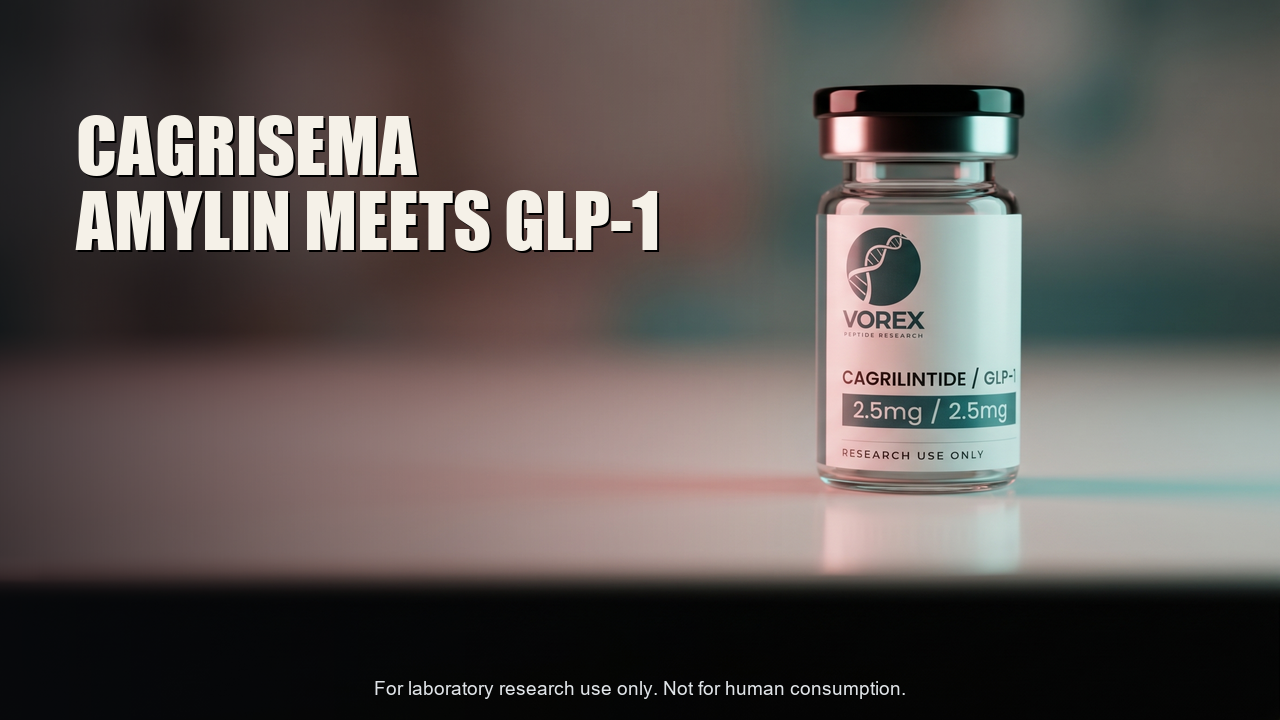
CagriSema is not a single molecule but a research combination: the long-acting amylin analog cagrilintide paired with the GLP-1 receptor agonist semaglutide. It is studied as a model for a recurring question in metabolic research — whether engaging two complementary satiety and metabolic pathways at once produces effects beyond either component alone. Rather than building one peptide that hits multiple receptors (the approach of tirzepatide and retatrutide), CagriSema combines two well-characterized peptides that act through distinct receptor systems: the amylin/calcitonin receptors and the GLP-1 receptor. That distinction makes the combination conceptually clean. Amylin and GLP-1 are different hormones with different receptors and partly overlapping, partly complementary downstream effects on satiety, gastric emptying, and glucose handling. Studying them together lets researchers ask how two satiety axes interact. This article surveys what the peer-reviewed literature describes about the two components and their combination, the principal reported findings, how the combination compares to single-molecule multi-agonists, and how research-grade material is handled. Everything is framed strictly for laboratory research use only; clinical findings are reported as observations from the published literature, not as claims about VOREX material and not as any form of human-use guidance.Mechanism of Action
CagriSema's mechanism is best understood as the sum of two distinct pathways. The amylin arm (cagrilintide). Cagrilintide is a long-acting acylated analog of human amylin, a 37-amino-acid hormone co-secreted with insulin from pancreatic beta cells. In research models it acts as a non-selective agonist of the amylin and calcitonin receptors, with effects on gastric emptying, glucagon suppression, and central satiety signaling. Its acylation confers a half-life consistent with once-weekly research administration (Lau et al., 2021). The GLP-1 arm (semaglutide). Semaglutide is a long-acting, DPP-4-resistant GLP-1-receptor agonist that potentiates glucose-dependent insulin secretion and engages central appetite circuits. (Its mechanism is treated in detail in the dedicated semaglutide research overview.) The rationale for the combination is that amylin and GLP-1 act on separate receptors and partly distinct satiety circuits, so engaging both simultaneously is hypothesized to produce additive metabolic effects — a hypothesis that combination research was designed to examine (Enebo et al., 2021).Mechanism of Action — Deep Dive
Two satiety systems. Amylin-receptor signaling and GLP-1-receptor signaling both influence satiety, but through different receptor populations and partly different neural circuits. The research interest in CagriSema rests on the idea that these systems are complementary rather than redundant — that combining them recruits more of the satiety machinery than either alone. Disentangling which component drives a given readout requires studying each peptide separately and in combination, which is precisely the experimental design the combination enables. Why combine rather than fuse. Single-molecule multi-agonists (tirzepatide, retatrutide) achieve multi-receptor coverage within one engineered peptide. A two-peptide combination such as CagriSema achieves it by co-administration, which has a different research character: the two components can be dosed and studied independently, allowing their individual contributions and their interaction to be examined directly. For comparative pharmacology, this makes the combination a useful counterpart to the fused multi-agonist approach.Key Research Findings
The findings below are drawn from the peer-reviewed literature, presented as observations reported in those studies — not as outcomes attributable to VOREX material and not as human-use guidance.Finding 1 — Cagrilintide as a long-acting amylin analog
Type of evidence: randomized, placebo- and active-controlled phase 2 trial (Lau et al., 2021). Method context: dose-finding study of once-weekly cagrilintide in adults with overweight or obesity. Finding: cagrilintide produced significant weight reduction relative to placebo across the dose range studied. Why it matters: it established the amylin-analog component as an active research molecule in its own right (Lau et al., 2021).Finding 2 — Additive effects of the combination
Type of evidence: clinical pharmacology study of concomitant administration (Enebo et al., 2021). Method context: multiple-dose study of cagrilintide co-administered with semaglutide 2.4 mg. Finding: the combination reported additive effects on weight-related markers compared with the components studied alone, with pharmacokinetics supporting co-administration. Why it matters: it provided the proof-of-concept for the combined-pathway hypothesis that defines CagriSema (Enebo et al., 2021).Finding 3 — Phase 3 combination data
Type of evidence: later phase 3 investigation of the fixed combination (Frias et al., 2023, and subsequent REDEFINE-program reports). Finding: the combination reported substantial dose-dependent weight reduction in the studied populations; the REDEFINE 1 program reported a mean weight reduction of approximately 22.7% at 68 weeks in adults with obesity without diabetes. Why it matters: it extended the combination dataset into larger, longer studies that quantify the combined-pathway effect (Frias et al., 2023).Related Compounds Comparison Table
This comparison is descriptive biochemistry; none of these molecules is presented for any human use.| Approach | Composition | Receptor coverage | Research framing |
|---|---|---|---|
| CagriSema | Two peptides (cagrilintide + semaglutide) | Amylin/calcitonin + GLP-1 | Combination of two distinct satiety axes |
| Cagrilintide alone | Single peptide | Amylin/calcitonin | The amylin-arm component |
| Semaglutide alone | Single peptide | GLP-1 | The GLP-1-arm component |
| Tirzepatide | Single fused peptide | GIP + GLP-1 | Multi-receptor coverage within one molecule |
Research Applications
Within laboratory settings, the CagriSema components are studied as reference materials in amylin- and GLP-1-receptor pharmacology, in satiety and gastric-emptying models, and in comparative work that examines how two co-administered satiety axes interact. The combination's research value is that its components can be studied separately and together, allowing individual contributions and their interaction to be attributed directly. Receptor-selective antagonists are frequently paired with each component to confirm pathway specificity. Across all designs, the materials function as tools for interrogating combined metabolic signaling, never as products for application outside the laboratory.Storage & Handling Protocols for Research Use
Research-grade cagrilintide and semaglutide are typically supplied as lyophilized peptide powders, chosen because dry material is far more stable than material in solution. The considerations below are general laboratory-storage practice, not instructions for any human use. Dry powder is commonly stored at −20 °C or colder (often −80 °C for archival material), protected from moisture by desiccant and shielded from light. Because the powders are hygroscopic, laboratories equilibrate a sealed vial to room temperature before opening. Material in solution is prone to aggregation and hydrolysis, with stability sensitive to pH, temperature, and freeze–thaw cycling, so many groups prepare small single-use aliquots. Because no generic shelf life can be assumed, research groups validate stability empirically. VOREX does not provide reconstitution recipes, concentrations, or use protocols; those decisions sit with the qualified researcher.Laboratory Handling & Best Practices
Record each vial's lot number against every experiment, with working aliquots inheriting it.Use clean glassware and PPE, document storage history and freeze–thaw count, and weigh small quantities on a calibrated analytical balance, accounting for the hygroscopic tendency of lyophilized powders. For a two-component combination, lot tracking of each component separately is especially important for traceability. None of these practices involves dosing, route of administration, or human-use preparation.What the Research Doesn't Tell Us
The literature is candid about open questions. Because CagriSema is a combination, attributing a given effect to the amylin arm, the GLP-1 arm, or their interaction requires careful factorial design; "additive" findings are inferences from comparative data rather than direct mechanistic dissection. The human efficacy data come from trials with defined endpoints and durations, and results under one regimen or population cannot be assumed to generalize. The long-term consequences of sustained dual-axis satiety signaling remain an area of ongoing study. For the researcher, CagriSema is best approached as an open, actively evolving subject where the interaction between its two components is itself the question.Conclusion
CagriSema research describes a combination of two well-characterized peptides — the amylin analog cagrilintide and the GLP-1 agonist semaglutide — studied for whether engaging two distinct satiety axes produces effects beyond either alone. The reported combination data supply a quantitative reference for the additive-pathway hypothesis, and the combination's separable components make it a useful counterpart to single-molecule multi-agonists. It is a mechanism worth measuring, and for laboratories working on satiety and metabolic signaling its components remain valuable reference materials. View research data · Request COA · Explore mechanism studiesReferences
- Lau, D.C.W., Erichsen, L., Francisco, A.M., Satylganova, A., le Roux, C.W., McGowan, B., et al. (2021). Once-weekly cagrilintide for weight management in people with overweight and obesity: a phase 2 trial. The Lancet, 398(10317), 2160–2172. https://pubmed.ncbi.nlm.nih.gov/34798060/
- Enebo, L.B., Berthelsen, K.K., Kankam, M., Lund, M.T., Rubino, D.M., Satylganova, A., & Lau, D.C.W. (2021). Safety, tolerability, pharmacokinetics, and pharmacodynamics of concomitant administration of multiple doses of cagrilintide with semaglutide 2·4 mg. The Lancet, 397(10286), 1736–1748. https://pubmed.ncbi.nlm.nih.gov/33894838/
- Frías, J.P., Deenadayalan, S., Erichsen, L., Knop, F.K., Lingvay, I., Macura, S., et al. (2023). Efficacy and safety of co-administered once-weekly cagrilintide with once-weekly semaglutide in type 2 diabetes: a phase 2 trial. The Lancet, 402(10403), 720–730. https://pubmed.ncbi.nlm.nih.gov/37364590/
For laboratory and research use only (RUO). Not for human consumption, diagnostic, or therapeutic use. VOREX products are intended exclusively for in vitro research conducted by qualified professionals. Statements have not been evaluated by the FDA. These products are not intended to diagnose, treat, cure, or prevent any disease. Clinical findings described above are reported from the published peer-reviewed literature and are not claims regarding VOREX research material.