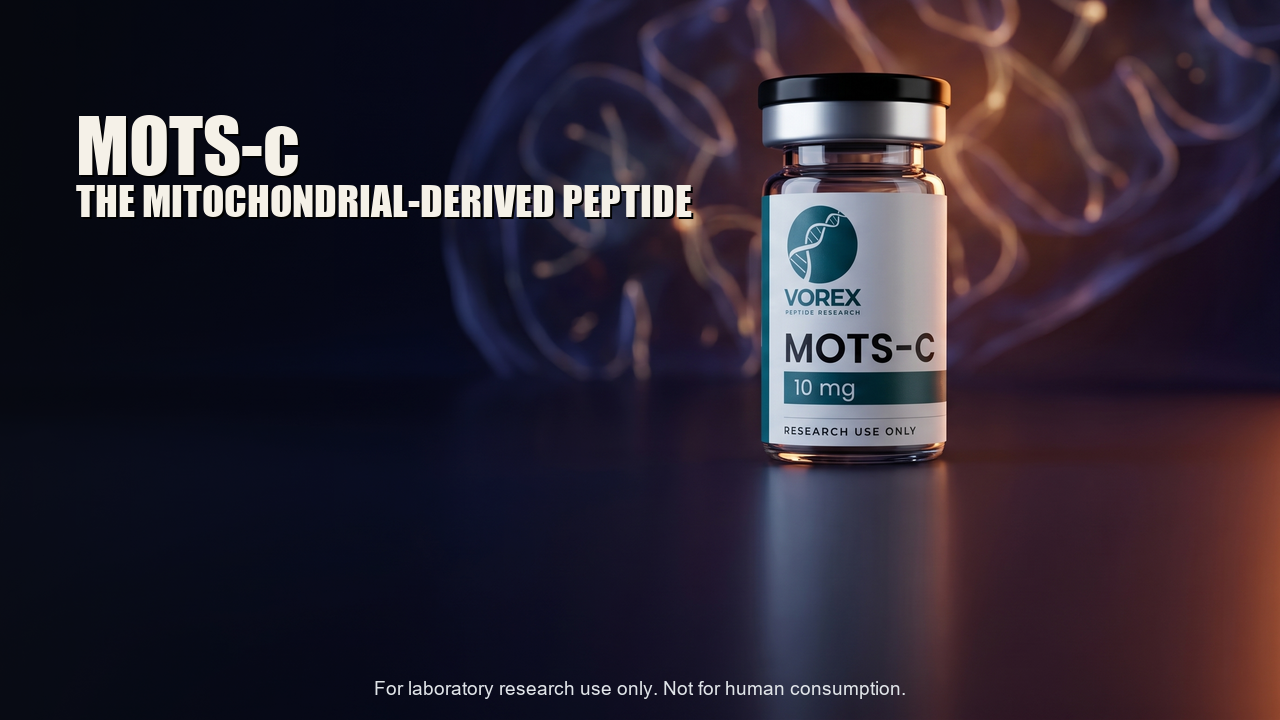
MOTS-c: The Mitochondrial-Derived Peptide in Metabolic Research
Introduction
MOTS-c (Mitochondrial Open Reading Frame of the 12S rRNA type-c) is a 16-amino-acid peptide with an unusual origin: it is encoded not in the nuclear genome but within the mitochondrial DNA itself, in a short open reading frame inside the 12S ribosomal RNA gene. It belongs to a class of bioactive molecules — mitochondrial-derived peptides (MDPs) — that overturned the long-held assumption that the mitochondrial genome encodes only the handful of proteins required for oxidative phosphorylation. In research models, MOTS-c functions as a regulator of metabolic homeostasis, acting through the cellular energy sensor AMP-activated protein kinase (AMPK). This article surveys what the peer-reviewed literature describes about its mechanism, the discovery that defined the MDP class, the principal preclinical findings, how it relates to metabolic and aging biology, and how research-grade material is handled. Everything is framed strictly for laboratory research use only; the findings are model-system observations, not human outcomes, and nothing here describes or implies any human use.Mechanism of Action
MOTS-c's central mechanism is the regulation of metabolic homeostasis via AMPK, the master cellular energy sensor that becomes active when cellular energy charge falls. In research models, MOTS-c is associated with AMPK activation and downstream effects on insulin sensitivity and the folate–methionine one-carbon metabolic cycle, linking it to how cells sense and respond to nutrient and energy availability (Lee et al., 2015). What makes MOTS-c mechanistically distinctive is its origin and signaling reach. As a mitochondrially encoded peptide, it represents a form of communication from the mitochondrion to the rest of the cell — and, in some research, to the nucleus, where MOTS-c has been described translocating under metabolic stress to influence gene expression. This positions it as a node in the emerging study of mitochondrial-to-nuclear signaling.Mechanism of Action — Deep Dive
A peptide from the mitochondrial genome. The discovery of MOTS-c established that short open reading frames within mitochondrial DNA can encode bioactive peptides. This was a conceptual shift: the mitochondrial genome was shown to participate in metabolic signaling beyond its classical role in the electron-transport chain. MOTS-c is one of the first and best-characterized members of this MDP class (Lee et al., 2015). AMPK and metabolic homeostasis. AMPK integrates signals of cellular energy status and, when activated, shifts metabolism toward energy production and away from consumption. MOTS-c's association with AMPK activation is the mechanistic basis for its effects on insulin sensitivity and substrate metabolism in research models, making it a tool for studying how a mitochondrial signal feeds into central metabolic control (Lee et al., 2015). Exercise and aging context. Subsequent research described MOTS-c as an exercise-responsive, mitochondrial-encoded regulator with relevance to age-dependent physical decline and skeletal-muscle homeostasis, and reported age-dependent declines in circulating MOTS-c levels. This connects the peptide to both exercise physiology and aging biology in model systems (Reynolds et al., 2021).Key Research Findings
The findings below are model-system observations from the peer-reviewed literature — not human outcomes and not human-use guidance.Finding 1 — Identification as a metabolic regulator
Type of evidence: discovery study in mouse models (Lee et al., 2015). Finding: MOTS-c was identified as a mitochondrial-derived peptide that regulates insulin sensitivity and metabolic homeostasis, acting through AMPK. Why it matters: it defined both the peptide and the broader MDP concept (Lee et al., 2015).Finding 2 — Exercise responsiveness and muscle homeostasis
Type of evidence: study integrating cell, animal, and human-tissue data (Reynolds et al., 2021). Finding: MOTS-c behaves as an exercise-induced regulator relevant to age-dependent physical decline and skeletal-muscle homeostasis, with age-related declines in circulating levels described. Why it matters: it extends MOTS-c research into exercise physiology and aging biology (Reynolds et al., 2021).Related Compounds Comparison Table
| Molecule | Origin / class | Primary research arm | Relationship to MOTS-c |
|---|---|---|---|
| MOTS-c | Mitochondrial-derived peptide (16 aa) | AMPK; metabolic homeostasis | The reference molecule |
| Humanin | Mitochondrial-derived peptide | Cytoprotection | Another MDP class member |
| NAD⁺ | Redox coenzyme | Sirtuin/metabolic signaling | Related metabolic/aging research node |
| AICAR | AMPK activator (small molecule) | Direct AMPK activation | Shares the AMPK pathway |
Research Applications
Within laboratory settings, research-grade MOTS-c is studied in mitochondrial-derived-peptide research, AMPK-pathway investigation, insulin-sensitivity models, and aging biology. It functions as a defined reference input for probing mitochondrial-to-cellular metabolic signaling. Researchers commonly pair MOTS-c studies with AMPK-activation readouts, metabolic-flux assays, and gene-expression profiling to connect the peptide to functional metabolic outcomes. Across all designs, MOTS-c serves as a tool for interrogating metabolic and mitochondrial biology, never as a product for application outside the laboratory.Storage & Handling Protocols for Research Use
Research-grade MOTS-c is typically supplied as a lyophilized peptide powder, chosen because dry material is far more stable than material in solution. The considerations below are general laboratory-storage practice, not instructions for any human use. Dry powder is commonly stored at −20 °C or colder (often −80 °C for archival material), protected from moisture by desiccant and shielded from light. Because the powder is hygroscopic, laboratories equilibrate a sealed vial to room temperature before opening. Material in solution is prone to degradation, with stability sensitive to pH, temperature, and freeze–thaw cycling, so many groups prepare small single-use aliquots. Because no generic shelf life can be assumed, research groups validate stability empirically. VOREX does not provide reconstitution recipes, concentrations, or use protocols; those decisions sit with the qualified researcher.Laboratory Handling & Best Practices
Record the vial's lot number against every experiment, with working aliquots inheriting it.Use clean glassware and PPE, document storage history and freeze–thaw count, and weigh small quantities on a calibrated analytical balance, accounting for the hygroscopic tendency of lyophilized powders. None of these practices involves dosing, route of administration, or human-use preparation; they exist to protect data integrity and reproducibility.What the Research Doesn't Tell Us
The literature is candid about its limits. The defining metabolic data comes largely from mouse models and cell systems framed as model-system observations. The full scope of MOTS-c signaling — including the conditions under which it translocates to the nucleus and the breadth of its gene-expression effects — is still being mapped. Results in one model may not generalize, and the relationship between circulating MOTS-c, exercise, and aging continues to be characterized. For the researcher, MOTS-c is best approached as a young, actively evolving subject where careful controls and honest reporting of limitations matter.Conclusion
MOTS-c research describes a 16-amino-acid mitochondrial-derived peptide that signals metabolic state through AMPK — one of the first demonstrations that the mitochondrial genome encodes bioactive regulators of cellular metabolism. Connected to exercise physiology and aging biology in model systems, it is a mechanism worth measuring rather than a claim worth selling, and for laboratories working on metabolic and mitochondrial biology it remains a valuable reference material. View research data · Request COA · Explore mechanism studiesReferences
- Lee, C., Zeng, J., Drew, B.G., Sallam, T., Martin-Montalvo, A., Wan, J., et al. (2015). The mitochondrial-derived peptide MOTS-c promotes metabolic homeostasis and reduces obesity and insulin resistance. Cell Metabolism, 21(3), 443–454. https://pubmed.ncbi.nlm.nih.gov/25738459/
- Reynolds, J.C., Lai, R.W., Woodhead, J.S.T., Joly, J.H., Mitchell, C.J., Cameron-Smith, D., et al. (2021). MOTS-c is an exercise-induced mitochondrial-encoded regulator of age-dependent physical decline and muscle homeostasis. Nature Communications, 12, 470. https://pubmed.ncbi.nlm.nih.gov/33473115/
For laboratory and research use only (RUO). Not for human consumption, diagnostic, or therapeutic use. VOREX products are intended exclusively for in vitro research conducted by qualified professionals. Statements have not been evaluated by the FDA. These products are not intended to diagnose, treat, cure, or prevent any disease.