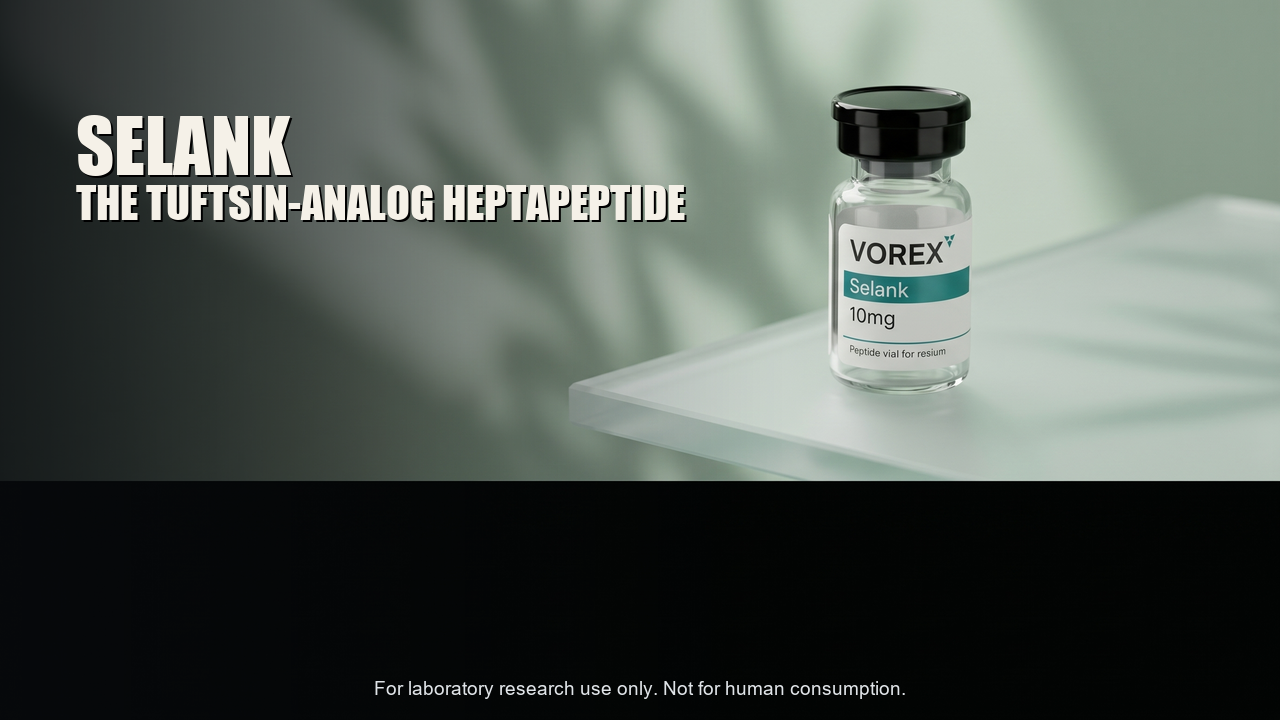
Selank: A Tuftsin-Analog Heptapeptide in Regulatory-Neuropeptide Research
Introduction
Regulatory peptides occupy a distinctive niche in neurochemistry: they are short, endogenously derived sequences that modulate signaling rather than driving it outright, and a small number of them have served as the structural starting points for an entire generation of synthetic research compounds. Selank is one of the clearest examples. It is a synthetic heptapeptide with the sequence Thr-Lys-Pro-Arg-Pro-Gly-Pro, built directly on the endogenous immunomodulatory tetrapeptide tuftsin and studied in preclinical and in-vitro systems as a regulatory neuropeptide. This article is a structural and mechanistic overview of Selank at the level of its peptide architecture and its lineage in the regulatory-peptide literature. It describes what Selank is as a molecule, how its tuftsin-derived design confers the stability that makes it tractable in research, and how that design situates it within the broader family of synthetic peptides modeled on natural regulatory sequences. Everything here is framed strictly for laboratory research use only. The observations are drawn from rodent-model and in-vitro studies and from the medicinal-chemistry literature — not human outcomes, and nothing here describes, recommends, or implies any human use.Mechanism of Action
Selank is best understood first as a structure and only then as an activity. Its parent molecule, tuftsin, is a naturally occurring tetrapeptide — Thr-Lys-Pro-Arg — released from the heavy chain of immunoglobulin G and long characterized in the literature as an immunomodulatory regulatory peptide. Tuftsin itself is short-lived: endogenous tetrapeptides are rapidly cleaved by aminopeptidases and other proteases, which limits their utility as reproducible reference compounds. Selank addresses this directly. It retains the complete Thr-Lys-Pro-Arg tuftsin recognition core and extends it with a Pro-Gly-Pro C-terminal tail, producing the stabilized heptapeptide Thr-Lys-Pro-Arg-Pro-Gly-Pro (Kolomin et al., 2013). The Pro-Gly-Pro extension is not arbitrary. Proline-rich motifs are well documented in peptide chemistry as conferring resistance to enzymatic degradation, because the rigid pyrrolidine ring of proline disrupts the conformations that many proteases require at their cleavage sites. By appending a proline-rich tail, the design of Selank yields a molecule that preserves the tuftsin pharmacophore while resisting the rapid breakdown that limits the native tetrapeptide. In the regulatory-peptide literature, Selank is therefore characterized as a proline-stabilized tuftsin analog — a research compound engineered for the kind of biochemical durability that controlled experimentation requires (Kolomin et al., 2013). Functionally, Selank is studied as a regulatory neuropeptide: a modulator described across rodent and in-vitro systems as touching GABAergic, serotonergic, and related signaling, with associated changes in neurotrophic-factor expression (Volkova et al., 2016). The unifying frame for this overview, however, is architectural — Selank is the stabilized synthetic descendant of an endogenous immunomodulatory tetrapeptide.Mechanism of Action — Deep Dive
The tuftsin recognition core. Tuftsin's biological identity is encoded in just four residues, Thr-Lys-Pro-Arg, and that sequence is the conserved heart of Selank. Preserving the core intact is what allows the synthetic analog to be discussed as a genuine tuftsin derivative rather than an unrelated peptide that merely shares a few residues. In the regulatory-peptide literature, this conservation of the recognition core is the defining feature that ties Selank's research profile to the decades of work on tuftsin itself (Kolomin et al., 2013). Why proline matters. The Pro-Gly-Pro extension does two things at once. First, the proline residues sharply restrict the local backbone conformation, which protects the adjacent peptide bonds from proteolytic cleavage. Second, that restriction stabilizes the molecule's overall shape, making its behavior in an assay more reproducible from preparation to preparation. For a researcher, reproducibility is the entire point of a reference compound: a peptide that degrades unpredictably is a poor experimental tool, whereas a proline-stabilized analog behaves consistently enough to support controlled comparison. A template for a generation of analogs. Selank does not stand alone. It belongs to a documented strategy in which natural regulatory peptides are used as templates for synthetic compounds that retain the parent's recognition motif while adding stabilizing modifications. The same medicinal-chemistry logic that produced Selank from tuftsin also produced related research peptides from other endogenous regulatory sequences (Kolomin et al., 2013). Situating Selank within this family clarifies that it is not an isolated molecule but a representative of a coherent, well-described design philosophy. From structure to signaling. Because the tuftsin core is preserved and the molecule is stabilized, Selank can be administered in rodent models and its downstream effects studied with confidence that the intact peptide is present. This is what links the structural overview here to the signaling literature: the architecture is the precondition for the reproducible modulation of GABAergic and serotonergic systems that other studies characterize (Volkova et al., 2016).Key Research Findings
The findings below are model-system, structural, and in-vitro observations from the peer-reviewed regulatory-peptide literature — not human outcomes and not human-use guidance.Finding 1 — A proline-stabilized tuftsin analog
Type of evidence: structural/medicinal-chemistry characterization in the regulatory-peptide literature (Kolomin et al., 2013). Method context: description of Selank as a synthetic analog of the endogenous tetrapeptide tuftsin, extended with a Pro-Gly-Pro tail. Finding: Selank (Thr-Lys-Pro-Arg-Pro-Gly-Pro) retains the complete tuftsin recognition core while the proline-rich C-terminal extension confers resistance to enzymatic degradation. Why it matters: the stabilization is what makes Selank tractable as a reproducible research compound where the native tetrapeptide would rapidly degrade (Kolomin et al., 2013).Finding 2 — Conservation of the endogenous tuftsin sequence
Type of evidence: sequence/structural characterization (Kolomin et al., 2013). Method context: comparison of the synthetic heptapeptide to its endogenous tetrapeptide parent. Finding: the Thr-Lys-Pro-Arg tuftsin core is preserved intact within the Selank heptapeptide, anchoring the analog to the established tuftsin literature. Why it matters: preserving the recognition core is what allows Selank to be studied as a true regulatory-peptide derivative rather than an unrelated synthetic sequence (Kolomin et al., 2013).Finding 3 — A regulatory neuropeptide active in CNS models
Type of evidence: in-vivo rodent gene-expression characterization (Volkova et al., 2016). Method context: administration of Selank in rodent models with assessment of central-nervous-system signaling readouts. Finding: the stabilized tuftsin analog is associated with modulation of GABAergic neurotransmission and related signaling in rodent brain tissue. Why it matters: it demonstrates that the architectural stability translates into measurable, reproducible central readouts, linking structure to function (Volkova et al., 2016).Related Compounds Comparison Table
This comparison is descriptive peptide biochemistry intended to orient research design; none of these molecules is presented for any human use.| Molecule | Class | Structural relationship | Relationship to Selank |
|---|---|---|---|
| Selank | Synthetic heptapeptide | Thr-Lys-Pro-Arg-Pro-Gly-Pro | The reference molecule (this article) |
| Tuftsin | Endogenous tetrapeptide | Thr-Lys-Pro-Arg | The natural parent; Selank's recognition core |
| Semax | Synthetic ACTH(4-10)-analog heptapeptide | Met-Glu-His-Phe-Pro-Gly-Pro | A separate proline-stabilized regulatory-peptide analog from the same design lineage |
Research Applications
Within laboratory settings, research-grade Selank is studied as a reference compound for tuftsin-analog pharmacology, as a defined input for investigations of regulatory-neuropeptide signaling in rodent models, and as a representative example of the proline-stabilization strategy used to derive durable synthetic peptides from natural regulatory sequences. It functions as a characterized tool compound for probing how a stabilized tuftsin core behaves in central and immune-adjacent research systems. Across these designs, Selank serves as a defined reference for regulatory-peptide research — never as a product intended for application outside the laboratory.Storage & Handling Protocols for Research Use
Research-grade Selank is typically supplied as a lyophilized peptide powder, a format chosen because dry material is markedly more stable than material in solution. The considerations below are general laboratory-storage practice and are not instructions for any human use. Dry powder is commonly stored at −20 °C or colder, with many laboratories using −80 °C for archival material, the vial protected from moisture by desiccant and shielded from light. Because the powder is hygroscopic, laboratories typically allow a sealed vial to equilibrate to room temperature before opening. Material brought into solution is far less stable than the dry form — prone to aggregation, surface adsorption, and hydrolysis, with stability sensitive to pH, temperature, and freeze–thaw cycling — so many groups prepare small single-use aliquots rather than repeatedly thawing one tube. Because no generic shelf life can be assumed across every laboratory's conditions, research groups validate stability empirically. VOREX does not provide reconstitution recipes, concentrations, or use protocols; those decisions sit with the qualified researcher.Laboratory Handling & Best Practices
Sound handling of a research reference peptide is largely about traceability and documentation. Record the vial's lot number against every experiment, and have any working aliquot inherit the parent lot identifier.Use clean glassware and appropriate personal protective equipment, document storage history and freeze–thaw count, and weigh small quantities on a calibrated analytical balance, accounting for the hygroscopic tendency of lyophilized powders. None of these practices involves dosing, route of administration, or human-use preparation; they exist to protect data integrity and reproducibility.What the Research Doesn't Tell Us
The literature is candid about the limits of this structural work. A conserved recognition core and a proline-stabilized backbone describe how the molecule is built and why it resists degradation; they do not, on their own, establish how the intact peptide is distributed or transformed inside an organism over time, where multiple enzymatic and signaling contexts interact. Characterizing Selank as a tuftsin analog clarifies its lineage but does not by itself map every receptor or pathway it engages — that requires deliberate, system-specific study. And the distance between a stabilized sequence in a rodent model and any real-world consequence is rarely small. For the researcher, the value of Selank in this context is precisely its well-defined, tuftsin-anchored architecture — a reliable structural foundation against which more specific mechanistic questions can be asked.Conclusion
Selank is, at the level of peptide architecture, a synthetic heptapeptide — Thr-Lys-Pro-Arg-Pro-Gly-Pro — that preserves the endogenous tuftsin recognition core and extends it with a proline-rich tail for enzymatic stability. That design makes it a reproducible reference compound, and its lineage in the regulatory-peptide literature gives it a coherent, well-documented pedigree as a stabilized tuftsin analog. It is a structure worth characterizing rather than a claim worth selling — a defined tool compound for laboratories studying regulatory neuropeptides. View research data · Request COA · Explore mechanism studiesReferences
- Volkova, A., Bondarenko, E., Pchelintseva, E., et al. (2016). Selank Administration Affects the Expression of Some Genes Involved in GABAergic Neurotransmission. Frontiers in Pharmacology, 7, 31. https://pubmed.ncbi.nlm.nih.gov/26941642/
- Kolomin, T., Shadrina, M., Slominsky, P., Limborska, S., & Myasoedov, N. (2013). A new generation of drugs: synthetic peptides based on natural regulatory peptides. Neuroscience and Medicine, 4(4), 223–252. https://doi.org/10.4236/nm.2013.44035
For laboratory and research use only (RUO). Not for human consumption, diagnostic, or therapeutic use. VOREX products are intended exclusively for in vitro research conducted by qualified professionals. Statements have not been evaluated by the FDA. These products are not intended to diagnose, treat, cure, or prevent any disease.