The KLOW Blend (GHK-Cu / KPV / BPC-157 / TB-500): Four-Peptide Matrix & Inflammation Research
Introduction
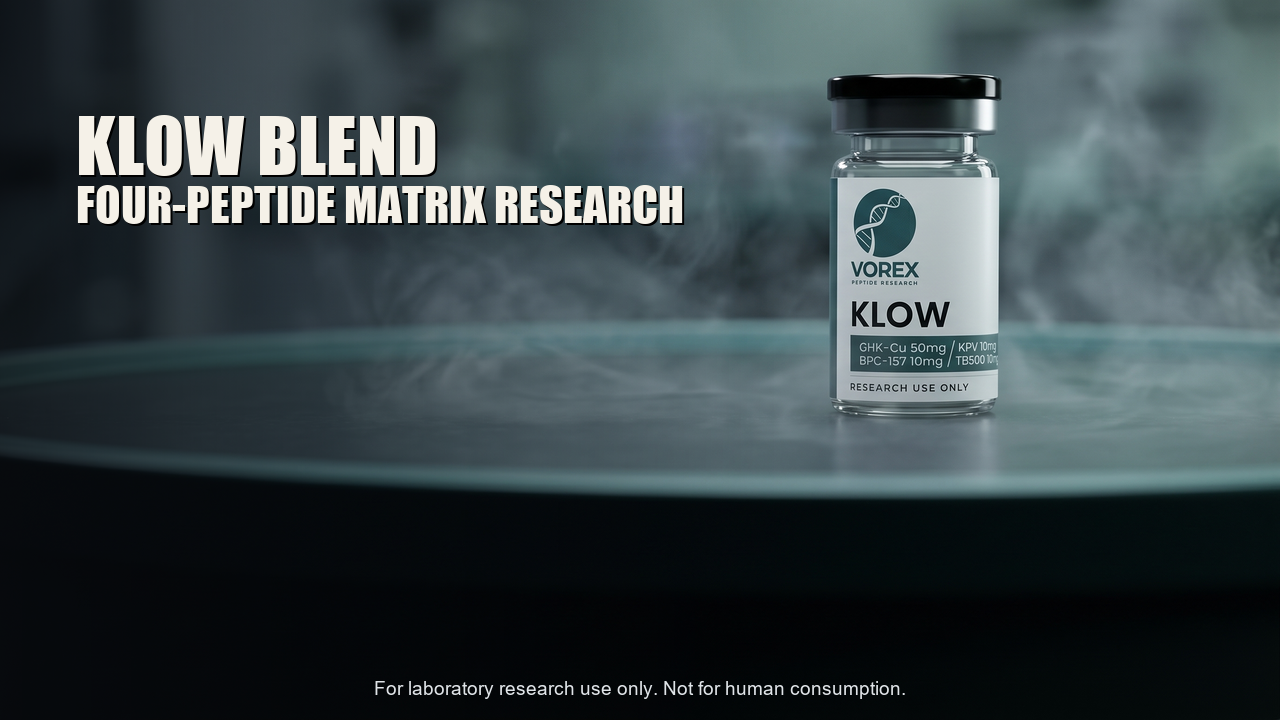
The KLOW blend is a four-peptide research combination — GHK-Cu, KPV, BPC-157, and TB-500 — assembled around two intersecting research themes: extracellular-matrix (ECM) remodeling and inflammation. It extends the three-peptide GLOW concept by adding KPV, a small anti-inflammatory tripeptide, broadening the combination's research relevance from primarily matrix/repair biology toward inflammation as well. As with all blends, KLOW is studied by reference to the established research base of its individual components and the rationale for combining them. This article surveys what the peer-reviewed literature describes about each component, why they are studied together, the principal findings, and how research-grade material is handled. Everything is framed strictly for laboratory research use only; the findings are model-system observations, not human outcomes, and nothing here describes or implies any human use.Mechanism of Action
KLOW's research rationale rests on four complementary mechanisms. GHK-Cu — ECM remodeling and gene modulation. The copper-binding tripeptide modulates expression of thousands of genes related to ECM synthesis, antioxidant response, and DNA repair, upregulating collagen and other matrix components in fibroblast research (Pickart & Margolina, 2018). KPV — anti-inflammatory signaling. KPV (Lys-Pro-Val) is the C-terminal tripeptide of α-melanocyte-stimulating hormone (α-MSH). It retains the parent hormone's anti-inflammatory activity but lacks the sequence required for melanocortin-receptor binding and pigmentation. Mechanism research describes inhibition of NF-κB signaling, suppression of pro-inflammatory cytokines (TNF-α, IL-1β, IL-6), and effects on epithelial-barrier integrity (Xiao et al., 2017). BPC-157 — angiogenesis and cytoprotection. A stable 15-amino-acid peptide studied for angiogenic and cytoprotective signaling in preclinical models. TB-500 — cytoskeletal regulation. Thymosin β4 sequesters G-actin to regulate cell-migration and remodeling dynamics (Goldstein et al., 2005). The combination is studied on the premise that ECM remodeling, anti-inflammatory signaling, angiogenesis/cytoprotection, and cytoskeletal regulation are partly distinct, partly overlapping arms of repair and inflammation biology.Mechanism of Action — Deep Dive
Adding inflammation to the repair picture. Where GLOW focuses on matrix and repair, KLOW's inclusion of KPV brings an explicit anti-inflammatory arm. Inflammation and tissue repair are tightly coupled biological processes, so a combination spanning both is of research interest for studying their interaction. KPV's mechanism — NF-κB inhibition and cytokine suppression without melanocortin-receptor engagement — makes it a clean anti-inflammatory component (Xiao et al., 2017). Characterizing components, not the blend. Consistent with research practice for combinations, KLOW is studied by reference to each component's peer-reviewed literature rather than as a unified product with its own asserted outcome. The research rationale is the combination of independently characterized mechanisms.Key Research Findings
The findings below are model-system observations from the component literature — not human outcomes and not human-use guidance.Finding 1 — KPV suppresses inflammatory markers
Type of evidence: colitis-model research (Xiao et al., 2017). Finding: KPV-loaded nanoparticles selectively delivered to colonic epithelial cells and macrophages attenuated inflammatory markers in research models, consistent with NF-κB inhibition and cytokine suppression. Why it matters: it anchors the anti-inflammatory arm of the blend (Xiao et al., 2017).Finding 2 — GHK-Cu modulates ECM gene expression
Microarray studies report GHK-Cu modulates expression of more than 4,000 human genes with effects on collagen and ECM pathways (Pickart & Margolina, 2018).Finding 3 — TB-500 regulates the cytoskeleton
Tβ4 functions as the principal G-actin-sequestering peptide central to cell migration and tissue remodeling (Goldstein et al., 2005).Related Compounds Comparison Table
| Component | Class | Primary research arm |
|---|---|---|
| GHK-Cu | Tripeptide–copper complex | ECM remodeling; gene modulation |
| KPV | α-MSH C-terminal tripeptide | Anti-inflammatory (NF-κB) |
| BPC-157 | 15 aa peptide | Angiogenesis; cytoprotection |
| TB-500 / Tβ4 | 43 aa peptide | Actin sequestration; migration |
Research Applications
Within laboratory settings, the KLOW components are studied as reference materials in ECM-biology assays, NF-κB and inflammatory-cytokine research, epithelial-barrier-integrity models, angiogenesis assays, and cell-migration research. The blend's value for comparative work is that its components can be studied individually and together, allowing each arm's contribution to a composite matrix/inflammation readout to be examined. Across all designs, the materials serve as tools for interrogating matrix and inflammation biology, never as products for application outside the laboratory.Storage & Handling Protocols for Research Use
Research-grade KLOW components are typically supplied as lyophilized powder, chosen because dry material is far more stable than material in solution. The considerations below are general laboratory-storage practice, not instructions for any human use. Dry powder is commonly stored at −20 °C or colder (often −80 °C for archival material), protected from moisture by desiccant and shielded from light. Because the powder is hygroscopic, laboratories equilibrate a sealed vial to room temperature before opening. Material in solution is prone to degradation, with stability sensitive to pH (which also affects GHK copper coordination), temperature, and freeze–thaw cycling, so many groups prepare small single-use aliquots. Because no generic shelf life can be assumed, research groups validate stability empirically. VOREX does not provide reconstitution recipes, concentrations, or use protocols; those decisions sit with the qualified researcher.Laboratory Handling & Best Practices
Record the composite lot number against every experiment, with working aliquots inheriting it.For a four-component blend, traceability of the composite lot is essential. Use clean glassware and PPE, document storage history and freeze–thaw count, and weigh small quantities on a calibrated analytical balance. None of these practices involves dosing, route of administration, or human-use preparation.What the Research Doesn't Tell Us
The literature is candid about its limits. With four components, attributing a given effect to any one peptide or to their interaction requires extensive factorial design; the blend's rationale is the combination of independently characterized mechanisms, not a demonstrated synergistic human outcome. Much component data is in vitro or from animal models framed as model-system observations, and results in one model may not generalize. For the researcher, KLOW is best approached as a combination whose component contributions and interactions are themselves the research question.Conclusion
KLOW research describes a four-peptide combination — GHK-Cu, KPV, BPC-157, and TB-500 — spanning extracellular-matrix remodeling and anti-inflammatory signaling. Studied by reference to each component's peer-reviewed base, it is a combination worth investigating rather than a claim worth selling, and for laboratories working on matrix and inflammation biology its components remain valuable reference materials. View research data · Request COA · Explore mechanism studiesReferences
- Pickart, L., & Margolina, A. (2018). Regenerative and Protective Actions of the GHK-Cu Peptide in the Light of the New Gene Data. International Journal of Molecular Sciences, 19(7), 1987. https://pubmed.ncbi.nlm.nih.gov/29986520/
- Xiao, B., Xu, Z., Viennois, E., Zhang, Y., Zhang, Z., Zhang, M., et al. (2017). Orally Targeted Delivery of Tripeptide KPV via Hyaluronic Acid-Functionalized Nanoparticles Efficiently Alleviates Ulcerative Colitis. Molecular Therapy, 25(7), 1628–1640. https://pubmed.ncbi.nlm.nih.gov/28427840/
- Goldstein, A.L., Hannappel, E., & Kleinman, H.K. (2005). Thymosin beta4: actin-sequestering protein moonlights to repair injured tissues. Trends in Molecular Medicine, 11(9), 421–429. https://pubmed.ncbi.nlm.nih.gov/16099219/
For laboratory and research use only (RUO). Not for human consumption, diagnostic, or therapeutic use. VOREX products are intended exclusively for in vitro research conducted by qualified professionals. Statements have not been evaluated by the FDA. These products are not intended to diagnose, treat, cure, or prevent any disease.