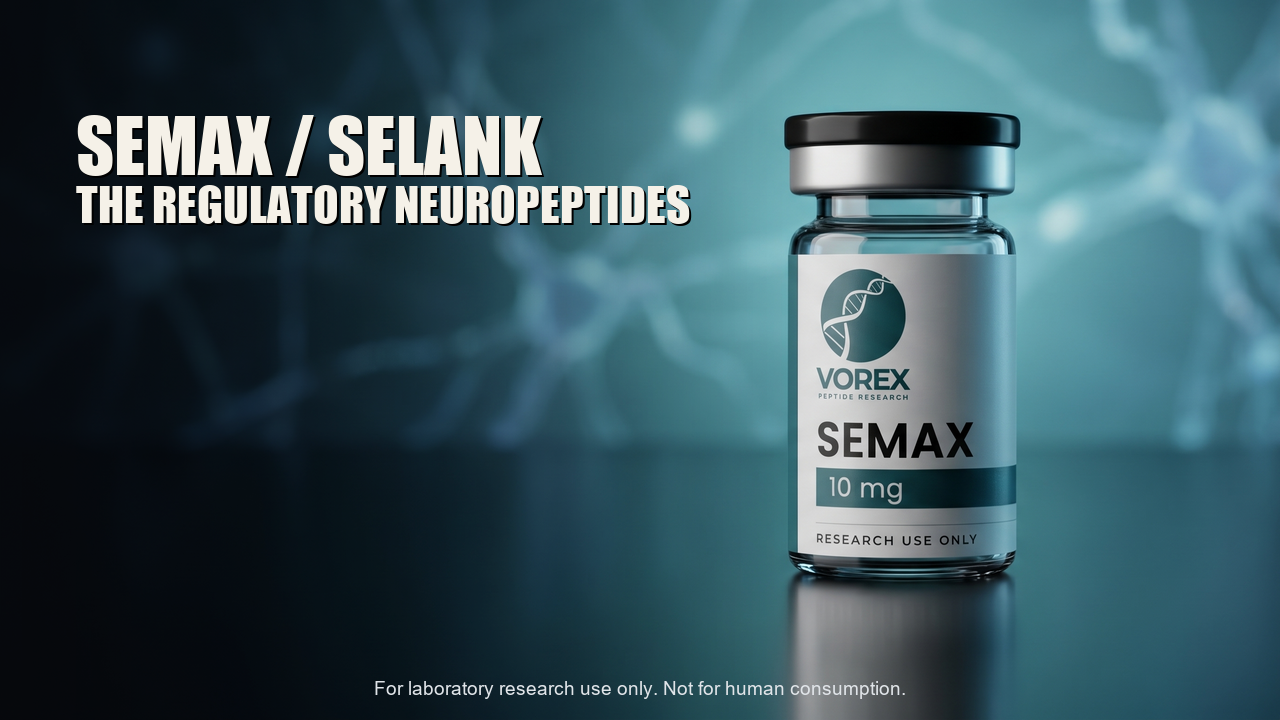
Semax and Selank: Two Regulatory Neuropeptides in CNS Research
Introduction
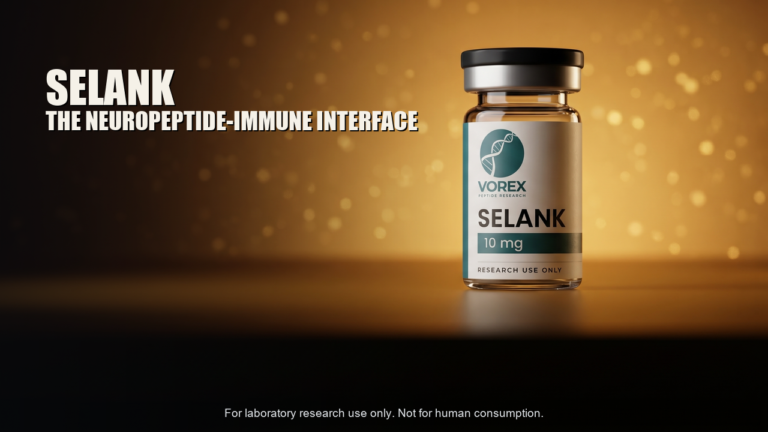
Semax and Selank are two synthetic heptapeptides developed from endogenous regulatory peptides and studied as research tools in central-nervous-system (CNS) biology. Though distinct in origin and primary activity, they are frequently grouped because both are short, enzymatically stabilized peptides that influence CNS gene expression and neurotransmission in research models — Semax derived from a fragment of adrenocorticotropic hormone (ACTH) and Selank derived from the immune-active tetrapeptide tuftsin. Together they illustrate a Russian school of "regulatory peptide" research that engineered small, stable analogs of natural signaling molecules for laboratory study. This article surveys what the peer-reviewed literature describes about each peptide's mechanism, the gene-expression and neurotransmitter findings that define them, how they compare to each other, and how research-grade material is handled. Everything is framed strictly for laboratory research use only; the findings are model-system observations, not human outcomes, and nothing here describes or implies any human use.Mechanism of Action
Semax — an ACTH(4-10) analog. Semax is a synthetic heptapeptide derived from the N-terminal fragment ACTH(4-10), extended with a C-terminal Pro-Gly-Pro sequence that confers enzymatic stability. Critically, it retains the neuromodulatory activity associated with the ACTH fragment while lacking the adrenocortical (corticosteroid-releasing) effects of the parent hormone. In research models, Semax modulates expression of brain-derived neurotrophic factor (BDNF) and nerve growth factor (NGF) in CNS tissue, affects monoaminergic neurotransmission, and influences melanocortin-receptor signaling (Dolotov et al., 2006). Selank — a tuftsin analog. Selank is a synthetic heptapeptide (Thr-Lys-Pro-Arg-Pro-Gly-Pro) developed as a stabilized analog of the endogenous tetrapeptide tuftsin. In preclinical research it is studied for modulation of GABAergic, serotonergic, and dopaminergic signaling, effects on BDNF expression, and interactions at the immune–CNS interface, including effects on enkephalin metabolism (Volkova et al., 2016). Both peptides therefore act as regulators of CNS gene expression and neurotransmission, but through different upstream lineages — neurotrophic/monoaminergic for Semax, GABAergic/serotonergic for Selank.Mechanism of Action — Deep Dive
Semax and neurotrophic signaling. A defining research observation for Semax is its effect on neurotrophic factors. Gene-expression studies report Semax-induced increases in BDNF and NGF in regions such as the hippocampus and basal forebrain, connecting a small peptide to the machinery of neuronal plasticity and survival in model systems. Separating ACTH(4-10)'s neuromodulatory activity from its hormonal effects is what makes Semax a clean research tool (Dolotov et al., 2006). Selank and neurotransmitter modulation. Selank's research signature is anxiolytic-like activity in rodent models without the sedative effects characteristic of benzodiazepines, alongside changes in the expression of genes involved in GABAergic neurotransmission. This positions Selank as a tool for studying anxiolytic mechanisms that operate differently from classical GABA-A modulators (Volkova et al., 2016). The vascular and ischemia dimension. Research on Semax has also examined effects on the expression of genes related to the immune and vascular systems in models of cerebral ischemia, extending its research relevance into the neurovascular interface (Medvedeva et al., 2017).Key Research Findings
The findings below are model-system observations from the peer-reviewed literature — not human outcomes and not human-use guidance.Finding 1 — Semax increases neurotrophic-factor expression
Type of evidence: rodent neurochemistry study (Dolotov et al., 2006). Finding: Semax bound specifically and increased BDNF protein levels in rat basal forebrain. Why it matters: it provides a concrete molecular readout linking the peptide to neurotrophic signaling (Dolotov et al., 2006).Finding 2 — Selank affects GABAergic gene expression
Type of evidence: gene-expression study (Volkova et al., 2016). Finding: Selank administration altered expression of genes involved in GABAergic neurotransmission, consistent with anxiolytic-like activity without sedation in behavioral models. Why it matters: it gives Selank a defined mechanistic signature distinct from benzodiazepine pharmacology (Volkova et al., 2016).Finding 3 — Semax in cerebral-ischemia models
Type of evidence: focal-ischemia gene-expression study (Medvedeva et al., 2017). Finding: Semax affected expression of immune- and vascular-system genes in rat brain focal ischemia. Why it matters: it extends Semax research into neurovascular and ischemia biology (Medvedeva et al., 2017).Related Compounds Comparison Table
| Peptide | Derived from | Primary research arm | Distinguishing feature |
|---|---|---|---|
| Semax | ACTH(4-10) fragment | BDNF/NGF; monoaminergic | Neuromodulation without adrenocortical effect |
| Selank | Tuftsin (tetrapeptide) | GABA/serotonin; immune–CNS | Anxiolytic-like, non-sedative in models |
Research Applications
Within laboratory settings, research-grade Semax and Selank are studied in BDNF/NGF expression research, ACTH-fragment and tuftsin-analog pharmacology, neurotransmitter-modulation studies, anxiolytic-mechanism research, and cerebral-ischemia and cognition models. They function as defined reference inputs for probing CNS gene-expression and neurotransmitter pathways. Researchers commonly pair these studies with mRNA/protein quantification of neurotrophic factors and receptor-subunit genes, and with behavioral assays in rodent models. Across all designs, the peptides serve as tools for interrogating CNS biology, never as products for application outside the laboratory.Storage & Handling Protocols for Research Use
Research-grade Semax and Selank are typically supplied as lyophilized peptide powders, chosen because dry material is far more stable than material in solution. The considerations below are general laboratory-storage practice, not instructions for any human use. Dry powder is commonly stored at −20 °C or colder (often −80 °C for archival material), protected from moisture by desiccant and shielded from light. Because the powders are hygroscopic, laboratories equilibrate a sealed vial to room temperature before opening. Material in solution is prone to degradation, with stability sensitive to pH, temperature, and freeze–thaw cycling, so many groups prepare small single-use aliquots. Because no generic shelf life can be assumed, research groups validate stability empirically. VOREX does not provide reconstitution recipes, concentrations, or use protocols; those decisions sit with the qualified researcher.Laboratory Handling & Best Practices
Record each peptide's lot number against every experiment, with working aliquots inheriting it.Use clean glassware and PPE, document storage history and freeze–thaw count, and weigh small quantities on a calibrated analytical balance, accounting for the hygroscopic tendency of lyophilized powders. None of these practices involves dosing, route of administration, or human-use preparation; they exist to protect data integrity and reproducibility.What the Research Doesn't Tell Us
The literature is candid about its limits. Much of the gene-expression and behavioral data comes from rodent models framed as model-system observations, and the precise molecular pathways linking these short peptides to their downstream effects are still being characterized. Results in one model or brain region may not generalize, and the relationship between acute gene-expression changes and sustained functional outcomes remains an open question. For the researcher, Semax and Selank are best approached as well-defined but mechanistically incompletely mapped CNS probes where careful controls matter.Conclusion
Semax and Selank research describes two synthetic regulatory heptapeptides — an ACTH(4-10) analog and a tuftsin analog — studied for their effects on CNS gene expression and neurotransmission. Semax is anchored to neurotrophic (BDNF/NGF) signaling, Selank to GABAergic/serotonergic modulation, and both are stable, tractable tools for neuroscience research. They are mechanisms worth measuring rather than claims worth selling, and for laboratories working on CNS biology they remain valuable reference materials. View research data · Request COA · Explore mechanism studiesReferences
- Dolotov, O.V., Karpenko, E.A., Inozemtseva, L.S., Seredenina, T.S., Levitskaya, N.G., Rozyczka, J., et al. (2006). Semax, an analog of ACTH(4-10), binds specifically and increases levels of brain-derived neurotrophic factor protein in rat basal forebrain. Journal of Neurochemistry, 97(s1), 82–86. https://pubmed.ncbi.nlm.nih.gov/16635253/
- Volkova, A., Shadrina, M., Kolomin, T., Andreeva, L., Limborska, S., Myasoedov, N., & Slominsky, P. (2016). Selank Administration Affects the Expression of Some Genes Involved in GABAergic Neurotransmission. Frontiers in Pharmacology, 7, 31. https://pubmed.ncbi.nlm.nih.gov/26941642/
- Medvedeva, E.V., Dmitrieva, V.G., Povarova, O.V., Limborska, S.A., Skvortsova, V.I., Myasoedov, N.F., & Dergunova, L.V. (2017). The peptide semax affects the expression of genes related to the immune and vascular systems in rat brain focal ischemia. Genes & Genomics, 39(5), 411–421. https://pubmed.ncbi.nlm.nih.gov/27812741/
For laboratory and research use only (RUO). Not for human consumption, diagnostic, or therapeutic use. VOREX products are intended exclusively for in vitro research conducted by qualified professionals. Statements have not been evaluated by the FDA. These products are not intended to diagnose, treat, cure, or prevent any disease.